How to Choose a Cooler Bag Supplier: A Buyer's Checklist
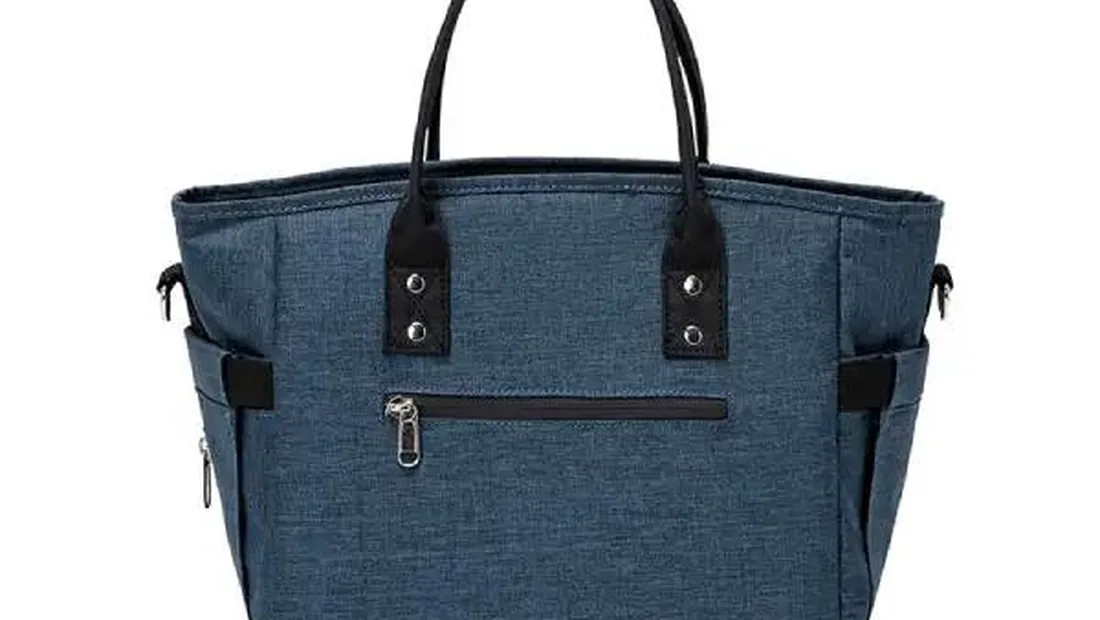
Choosing a cooler bag supplier is not a branding exercise. It's a sourcing decision with measurable failure points. You're not buying a bag. You're buying a temperature curve, a condensation outcome, and a sewing line that can repeat both at 5,000 units. The wrong cooler bag supplier will pass you a spec sheet and a smile. The right one will show you a test report and tell you what it doesn't prove.
This guide is built for buyers who need to separate thermal marketing from thermal engineering. No fluff. Just the checklist I'd use if I were auditing a factory for the first time.
1. Start With the Insulation, Not the Logo
Most cooler bags fail from the inside out. The shell fabric is rarely the problem. The problem is what sits between the shell and the liner, and whether it's continuous.
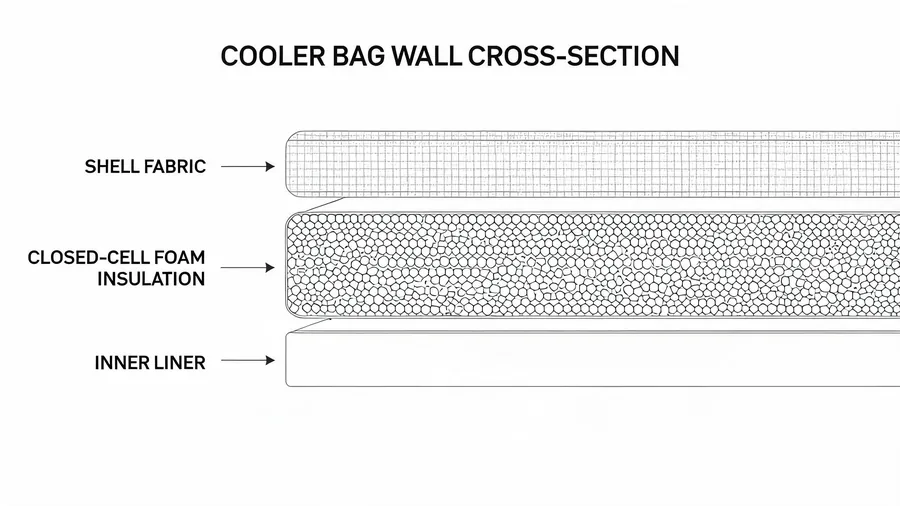
Ask what foam the supplier uses. Closed-cell polyethylene and polyurethane foam are the standard options. Open-cell foam is cheaper but absorbs water, loses loft when compressed, and turns a cooler bag into a damp sponge after one season. Closed-cell foam is the baseline for anything that will hold ice or chilled contents.
Then ask about thickness and density. A supplier should be able to state both. Not "premium insulation." A number, in millimeters, and a density figure. If they can't, they're reselling someone else's work.
The real problem is thermal bridging. This is where the insulation is compressed, interrupted, or replaced by a zipper, a plastic frame, a metal D-ring, or a seam. Heat moves through those points fast. A bag with 20mm foam in the panels and zero foam behind the zipper tape will underperform a 10mm bag with continuous coverage. You can't see this in a photo. You can only see it in a cut sample or a thermal camera image.
Ask for a cross-section sample. Cut one open yourself. If the supplier won't send one, move on.
2. Liner and Seam Construction: Where Condensation Actually Happens
Condensation is the silent killer of cooler bag performance. It wets the insulation, stains the liner, and breeds mold. The liner has to do two jobs: contain liquid and manage moisture without letting it reach the foam.
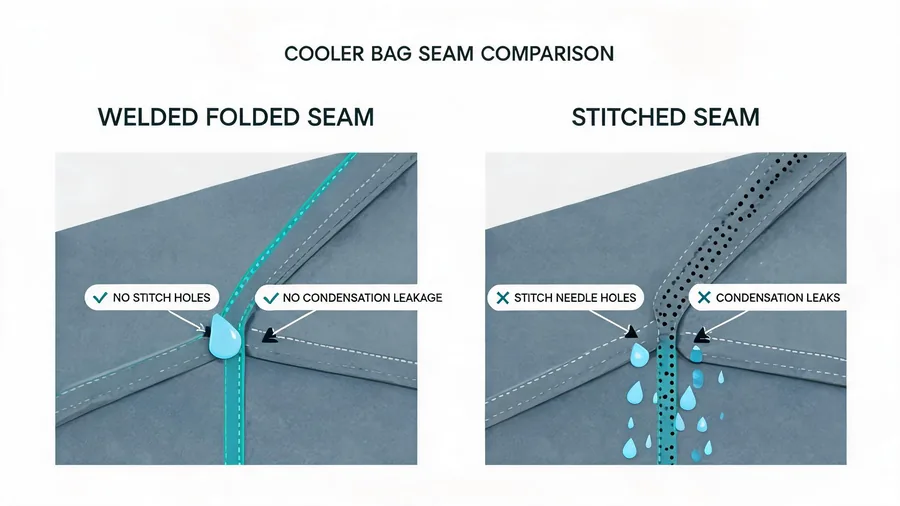
Look for a liner that's welded or heat-sealed, not just stitched. Stitched seams leak. Always. You can tape over them, but tape fails over time. Welded seams are the only reliable way to make a liner that holds water.
Ask what the liner material is. A metallized film or foil-faced layer can reduce radiant heat transfer when positioned correctly. But it's not magic. If the supplier claims a liner is "reflective," ask where it sits in the layer stack. A reflective barrier on the outside of the insulation does almost nothing. It has to be on the warm side, facing the interior, to reflect heat back out.
Then ask about the closure system. Zippers are convenient but leak air. Roll-top closures seal better but are slower to open. Overlapping flaps are the worst of both worlds. The right choice depends on your use case. A food delivery bag that opens and closes 50 times a shift needs a different closure than a medical transport bag that stays sealed for eight hours.
3. Thermal Testing: How to Spot a Marketing Number
Every cooler bag supplier claims their bag "keeps ice for 24 hours." Almost none of them can tell you what that means.
A credible thermal test report must state six things:
- The test method used
- Ambient temperature during the test
- Starting temperature of the contents
- Payload mass and type
- Refrigerant quantity and type
- The acceptance limit, meaning the temperature below which contents must stay for the stated hold time
If any of those is missing, the claim is worthless. A bag tested in a 15°C room with a 5kg pre-frozen payload will hold cold far longer than the same bag tested in a 30°C room with a half-empty load. Same bag. Different number. The supplier isn't lying. They're just not telling you the conditions.
Ask for the thermal profile. That's the time-based record of internal temperatures during the test. A single number, like "18 hours," is a summary. A profile shows you the curve. You want to see how long the contents stayed within the approved range, not just when the test ended.
Also ask how often they re-test. A supplier that tests once and quotes that number for three years is not a supplier. It's a lottery ticket.
4. Closure Systems: The Part Everyone Forgets
The closure is the weakest thermal point in any cooler bag. It's also the part buyers forget to evaluate.
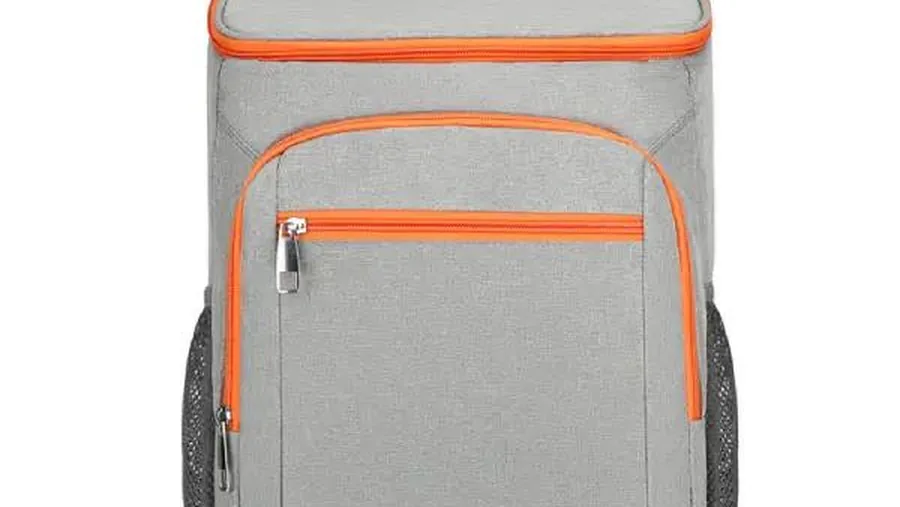
Zippers are the default. But not all zippers are equal. Ask about the zipper tape material, the coil size, and whether it's water-resistant. A standard zipper on a cooler bag is a hole. A water-resistant zipper is a smaller hole. Neither is a seal.
Roll-top closures are the best thermal performers. They create a folded barrier that traps air and reduces convective loss. But they're slower to open, and users hate them for high-frequency access. If your end user is a courier making 30 stops, a roll-top will get left open.
Overlapping flaps with hook-and-loop are common on promotional cooler bags. They're cheap and look fine. Thermally, they're poor. Air moves freely around the flap edges.
The right answer is usually a combination: a zipper for access plus an insulated flap for thermal performance. Ask the supplier to show you how the flap sits over the zipper. If there's a gap, the flap is decoration.
5. Production Consistency: The Unsexy Part That Matters Most
A supplier can make one perfect sample. That's easy. The question is whether they can make 5,000 identical ones.
Ask about their quality control process. Not the brochure version. The actual process. Do they run a zipper cycling test on every batch? Do they inspect seam strength on a defined sampling plan? Do they keep approved test reports linked to the exact material lot and component version?
Any supplier that can't answer those questions is doing inspection by eyeball. That works for a 100-unit order. It fails at scale.
Ask for their defect classification. Critical, major, minor. If they don't have one, they're deciding what's acceptable on the fly. That's how you get a container of cooler bags with skipped stitches and a shrug.
Also ask about change control. What happens when they switch foam suppliers? Or liner material? Or zipper vendor? A good supplier has a documented approval process. A bad one just... switches. You find out when your next order fails a thermal test.
6. What to Ask in Your RFQ
Here's the question list I'd send to any cooler bag supplier before spending a dollar on tooling. Copy it. Use it.
| Question | What a good answer looks like |
|---|---|
| What is the insulation material, thickness, and density? | Closed-cell PE or PU foam, stated in mm and kg/m³ |
| Can you provide a cross-section sample? | Yes, shipped within 48 hours |
| How is the liner sealed? | Welded or heat-sealed, not stitched |
| Where is the reflective barrier positioned? | On the warm side, facing the interior |
| Can you provide a thermal test report with all six parameters? | Yes, including method, ambient, starting temp, payload, refrigerant, acceptance limit |
| How often do you re-test thermal performance? | At least once per material or component change |
| What closure system do you recommend for my use case? | A specific recommendation with tradeoffs, not "whatever you want" |
| What is your defect classification system? | Critical, major, minor with documented acceptance criteria |
| What is your change control process for materials and components? | Documented approval flow with customer sign-off |
| Can you provide a golden sample for production reference? | Yes, approved before bulk production |
If a supplier answers "yes" to everything without asking about your use case, be suspicious. A good supplier asks questions back. What's your payload? What's your ambient temperature range? How long does it need to stay cold? What's your end user's access frequency? A supplier that doesn't ask those questions is selling you a stock bag with your logo on it.
That's fine if you're buying promotional giveaways. It's not fine if you're buying performance cooler bags for food delivery, medical transport, or premium retail.
One more thing. Ask about their minimum order quantity for custom insulation. If they say 500 pieces and you need 200, that's a real constraint. If they say "no minimum," they're either lying or selling you stock foam. Neither is good.
You can read more about cooler bag materials or check our OEM process if you want to see how a factory-side workflow should look. If you're still comparing options, the top cooler bag manufacturers guide might help you benchmark.
The best cooler bag supplier is not the one with the prettiest catalog. It's the one that can show you the test data, explain the failure points, and repeat the result. Everything else is just a bag.
FAQ
What is the difference between a cooler bag and an insulated bag?
All cooler bags are insulated bags, but not all insulated bags are cooler bags. A cooler bag is designed to hold temperature-sensitive contents with a refrigerant pack or ice. An insulated bag may only slow temperature change without a cold source. The insulation build, liner, and closure determine whether it can actually hold cold.
How do I verify a cooler bag supplier's thermal claims?
Ask for a thermal test report that states the test method, ambient temperature, starting temperature, payload, refrigerant quantity, and acceptance limit. A claim without those six parameters is not verifiable. Also ask for the thermal profile, the time-based temperature record, not just a single hold-time number.
What is the most common defect in cooler bags?
Thermal bridging at seams and hardware. This happens when insulation is compressed or interrupted by a zipper, frame, or D-ring. The bag looks fine but loses cold rapidly through those points. A cross-section sample will reveal it. Stitched liners that leak are the second most common.
Can a cooler bag supplier do custom insulation thickness?
Yes, but it depends on the supplier's foam sourcing and minimum order quantity. Some suppliers stock standard foam sheets and can only vary the number of layers. Others can source custom-density or custom-thickness foam, but usually with a higher MOQ. Ask for the specific foam specification before you commit.