Insulated Grocery Bag Bulk: A Wholesale Sourcing Guide
Insulated grocery bag bulk orders fail for boring reasons. Not because the foam was too thin, but because nobody wrote down the load, the trip length, or who washes the bag. A grocery chain, a CSA and a meal-kit brand all buy the same category and need three different bags. Here is how to spec yours before you ask anyone for a quote.
What Grocery and CSA Buyers Actually Need From a Bulk Insulated Bag
Say a regional grocer wants 6,000 insulated totes for a curbside program. The bag's real job is holding frozen and chilled product in range from the store to a doorstep, in July, on a route with forty stops. That is a thermal problem, not a design problem.
Here is what surprises first-time buyers. Opening frequency and zipper gaps usually cause more temperature loss than wall thickness. Every time a driver opens the lid at a stop, warm air enters and the cold mass has to recover. A thicker wall will not fix that.
Build your own checklist before you contact a supplier:
- Load size and shape: a full bag holds temperature better than a half-empty one, so match interior volume to the actual order profile.
- Trip length: fifteen minutes in a sedan and three hours in a van are different specifications.
- Cleaning routine: who wipes it, with what, and how often. This decides your liner.
- Branding surface: one large front panel, or a small mark on the lid?
- Storage at the depot: nested bags, folded bags and rigid bags stack very differently.
A spec sheet beats a photo every time. Send dimensions, fabric, foam, liner, closure, print method and packaging in writing, and quotes come back comparable. Send a picture of a competitor's bag and you will get guesses.
Shell Fabrics That Survive Repeated Loading
Polyester and nylon are the workhorse shells for a grocery program. Both are dimensionally stable and print well. Denier describes yarn linear density, and it does not directly state finished-fabric strength, so treat it as one input among several. Coating and weave matter just as much.
Polyurethane coating improves water resistance, hand feel and durability. PVC coating is stiffer and gives strong moisture resistance where surface protection matters. Neither is automatically better. A grocery bag that rides in a wet trunk argues for more coating; a bag that gets folded flat every night argues for less.
Canvas and cotton duck bring structure, texture and abrasion performance that synthetics struggle to match. The trade-offs are real: canvas is heavier and dries slowly. If your program involves condensation or rain, think hard before choosing it for the outer shell.
Ripstop constructions use reinforcement yarns in a grid to limit tear propagation. That helps when a bag snags on a cart or a shelf edge. Recycled-content programs can specify rPET fabric, which is widely available in the same weights and coatings.
Put this language in the PO: denier, GSM, coating type and coating weight, colorfastness requirement, and the test method for each. Vague fabric language is where disputes start.
Liners, Foam and Closures: The Thermal Core
Closed-cell PE foam, XPE foam and PU foam all appear in cooler bags. Cell structure and continuity matter more than thickness alone. Foam that gets compressed at a seam, or interrupted by a metal rivet, creates a thermal bridge and the wall stops working.
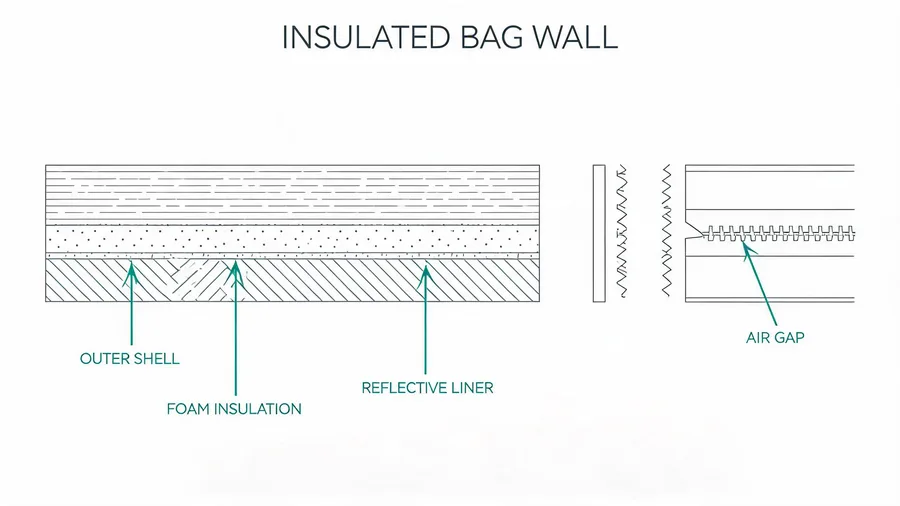
A metallized film or foil-faced layer reduces radiant heat transfer when it is correctly positioned in the construction. Placement decides whether it does anything. A reflective layer facing the wrong direction is decoration.
For the interior, EVA and TPU films give a cleanable surface and some moisture resistance. Heat-welded seams and waterproof zippers help control leaks and condensation. That combination matters for grocery programs carrying raw protein or melting ice.
| Component | Common options | What it does well | Where it struggles |
|---|---|---|---|
| Outer shell | Polyester, nylon, canvas, ripstop, rPET | Abrasion resistance, printability, weather protection | Canvas dries slowly; coating adds stiffness |
| Insulation | Closed-cell PE, XPE, PU foam | Reduces conductive and convective heat transfer | Compressed or interrupted foam creates thermal bridges |
| Reflective barrier | Metallized film, foil-faced layer | Cuts radiant heat when correctly placed | Wrong placement wastes the material |
| Inner liner | EVA film, TPU film, PEVA | Cleanable, moisture resistant, weldable | Thin films can crease and trap odor |
| Closure | Zipper, roll-top, overlapping flap | Controls air exchange at the opening | Different sealing performance; zipper gaps leak |
Closures deserve their own conversation. A zipper seals well until the teeth gap under load. A roll-top closure folds and compresses, which seals well but slows a driver down. An overlapping flap is fast and forgiving, and leaks the most. Pick based on your route, not the catalog.
Print and Logo Methods, and How They Set Your Minimums
Decoration method, artwork complexity and panel size drive minimum quantity far more than the bag itself. That is the part buyers miss.
Screen printing forces ink through a prepared screen and suits solid colors and repeat production. Digital textile printing handles detailed graphics and shorter runs, with ink chemistry selected for the fiber. Dye sublimation bonds disperse dye into suitable polyester surfaces under heat and pressure, which makes it a natural fit for polyester shells with photographic artwork.
Heat-transfer graphics are applied with heat and pressure, and adhesion, stretch, wash and abrasion performance all need validation on your actual substrate. Embroidery stitches thread into the material for a durable raised design, though backing, needle selection, stitch density and panel distortion need control.
For a lower-cost branded touch, consider a woven label, a printed label, or debossing and embossing. A debossed mark on a flap costs less than a printed panel and survives washing.
Color matching needs discipline. Work from a Pantone reference, approve under the lighting your customer will see, and approve the physical sample before bulk. Screen-to-bag color drift is normal and expensive to fix after production.
For a deeper look at how decoration choices interact with bag construction, see the insulated grocery bags guide.
Packaging, Presentation and Retail-Ready Options
Packaging is a line item, and it adds handling steps. Decide it before production starts, not after.
- Poly bag: the default for bulk carton delivery to a distribution center.
- Color box: retail shelf presence, more cost and more packing labor.
- Gift box with handle bag: premium gifting or holiday programs.
- Branded poly mailer: direct-to-consumer and subscription fulfillment.
- Hang tag plus poly bag: a middle path for retail without a full box.
- Dust bag: reusable presentation for a premium reusable bag.
If a grocery chain needs retail-ready units, each bag gets packed, labeled and cased for a store, not a DC. That changes your carton count, your labor and your schedule.
Labeling is not optional. Care, composition and origin information belong on a printed or thermal-transfer label, and the content depends on the market you sell into. For US programs, the CPSC publishes current labeling guidance, and buyers should check current guidance rather than rely on a supplier's summary.
Sampling, Production and Lead Time: What to Expect
Imagine a CSA ordering 1,200 insulated totes for a summer season. The first step is a paid sample, and that is normal. A sample round is meant to prove the construction, the print position, the color and the closure, not to be a free gift.
The sequence runs like this: inquiry and confirmation, quotation and agreement, sampling, material purchase, production, quality control, packing, shipment. Each stage can stretch. Artwork changes, a special fabric with a longer mill lead time, and peak season all push the schedule. Shipping mode does too. Air freight and express move faster than sea freight, and sea freight is the slowest and cheapest.
Settle Incoterms, port of departure and consolidation questions before the PO is signed. Those three items cause more last-minute arguments than anything on the production floor. For a full walkthrough of the order stages, the OEM process page lays them out step by step.
Buyers comparing insulated grocery bags wholesale should compare like for like. Ask every supplier for the same spec sheet, the same packaging line item and the same shipping term. Quotes that look cheap usually differ somewhere in the fine print.
Cold-Chain Terms Every Buyer Should Put in Writing
Temperature claims are meaningless without context. That is the whole point of cold-chain vocabulary.
Hold time is the period during which contents stay within a defined range under stated test conditions. Thermal profile is the time-based record of temperatures measured during a test or shipment. A temperature excursion is any period when the measured temperature moves outside the approved range. Conditioning means bringing the bag, contents and refrigerant packs to specified starting temperatures before testing. Payload is the temperature-sensitive contents, excluding the bag and its packaging.
Any temperature claim needs the test method, ambient condition, starting temperature, load, refrigerant quantity and acceptance limit stated alongside it. Without those, the number means nothing. Write an acceptance criterion your supplier and your QA team both understand, and test against it before you commit to a season.
Pre-chill contents and condition refrigerant packs correctly before a run. A bag tested warm will fail a test that a conditioned bag passes.
When you have a spec ready, send it through the contact page and ask for a quote against your written requirements.
FAQ
What is the best insulated bag for groceries?
There is no single best bag, only the best match for your route and load. A short curbside trip with a full load needs less insulation than a long multi-stop delivery route. Focus on closure quality first, because opening frequency and zipper gaps usually cause more temperature loss than wall thickness. Then match shell fabric to your cleaning routine and liner to what you carry.
What is the difference between thermal bags and insulated bags?
In practice the terms overlap and suppliers use them loosely. Both describe a bag built with an insulating layer to slow heat transfer. A thermal bag usually implies a defined cold-chain purpose, with hold time and a test condition behind the claim. An insulated bag may simply mean a bag with foam in the wall. When you buy, ask for the construction and the test method rather than the label.
What should a bulk insulated grocery bag order include?
Put dimensions, shell fabric with denier and GSM, coating type, foam type, liner material, closure style, print method and position, packaging format, labeling content, carton configuration, shipping term and destination port in writing. Add the acceptance criteria for any thermal claim. A written spec makes quotes comparable and gives both sides something to check against at inspection.
How do you compare quotes for insulated grocery bags wholesale?
Send the same spec sheet to every supplier and require the same packaging line item and shipping term. Then compare construction details, not headline numbers. Check whether the foam type and liner match your spec, whether the closure is the one you asked for, and whether labeling and retail packaging are included. Ask for process photos of the relevant production line and request the certificates that apply to your order.