Insulated Grocery Bags for Retail and Delivery Programs
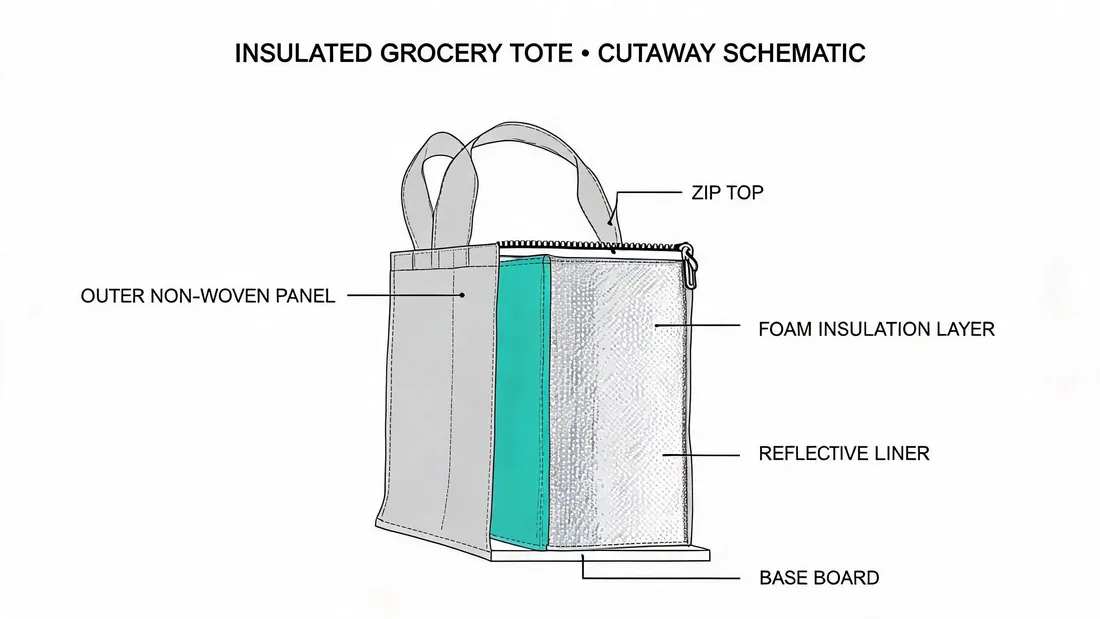
An insulated grocery bag is not a small cooler. It's a short cold-chain transfer carrier built to move chilled or frozen goods from a store shelf or a delivery van to a home refrigerator. Buyers who treat it as a cheap cooler bag end up with the wrong foam, the wrong liner, and a product that fails in real use. The right question isn't "does it hold ice?" but "how long does it need to hold a chilled load between two controlled environments?"
At Camytonc, we build these bags for retailers, grocery delivery fleets, and promotional buyers. The spec changes with the programme. A checkout tote for a supermarket chain isn't the same product as a home delivery bag for a meal kit company. This guide separates the two and gives you the fields to specify.
Insulated grocery bags vs. cooler bags: what buyers are actually specifying
A reusable grocery tote with an insulated liner is a shopping bag first. It's designed to sit in a basket, fold flat at the checkout, and carry groceries for a short drive home. The insulation is there to slow temperature rise, not to hold ice for a picnic. A purpose-built cooler bag is a different animal. It has a thicker foam layer, a more aggressive closure, and often a sealed liner. The two products look similar on a shelf. They perform very differently in a delivery van.
Grocery programmes care about basket fit, foldability, and checkout speed. Hold time is secondary. A bag that keeps milk cold for six hours but takes thirty seconds to open at the register is a failure. A bag that folds flat and opens instantly but only holds temperature for forty minutes may be perfect. The buyer needs to know which trade-off they are buying.
Position grocery coolers as short cold-chain transfer carriers. The cold chain is a controlled sequence of storage and transport intended to keep temperature-sensitive contents within an approved range. A grocery bag covers the last leg. It doesn't need to be a long-duration ice chest. If your programme requires multi-hour hold times, look at our food delivery cooler bags or medical cooler bags instead.
Capacity bands and why grocery bags are sized to the basket, not to cans
Consumers think in can counts. A "30-can cooler" is a familiar shorthand. It's also useless for B2B specification. Can diameter varies, pack configuration varies, and the number that matters is usable volume in litres. The dimensions that fit a shopping basket or a delivery tote matter just as much.
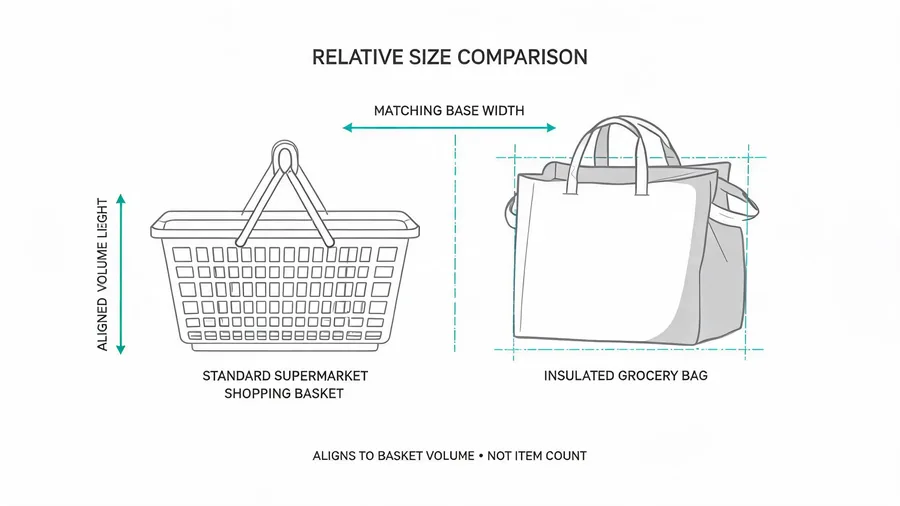
Grocery bags are sized to the basket. A standard supermarket basket holds a certain volume, and a bag that is too wide or too tall won't sit properly. It will tip, block the scanner, or slow the cashier. The bag should be slightly smaller than the basket interior, with enough structure to stand open but enough flex to fold flat when empty.
Fuller loads reduce internal temperature fluctuation. A smaller air volume means less warm air to cool and less cold air to lose. A bag packed to eighty percent of its volume will hold temperature better than the same bag packed to forty percent. This is why capacity bands should be specified as a range, not a single number. A 20-litre bag is not the same product as a 35-litre bag, even if both are called "large grocery coolers."
Materials and thermal system: non-woven PP, PEVA, 600D polyester, and foam
Two material systems dominate this category. The first is non-woven polypropylene with a PEVA liner. This is the classic promotional grocery tote. It's cheap, lightweight, and printable. The insulation is usually a thin foam layer or none at all. The PEVA liner provides some liquid containment and wipe-clean convenience. This is a short-use product, not a delivery workhorse.
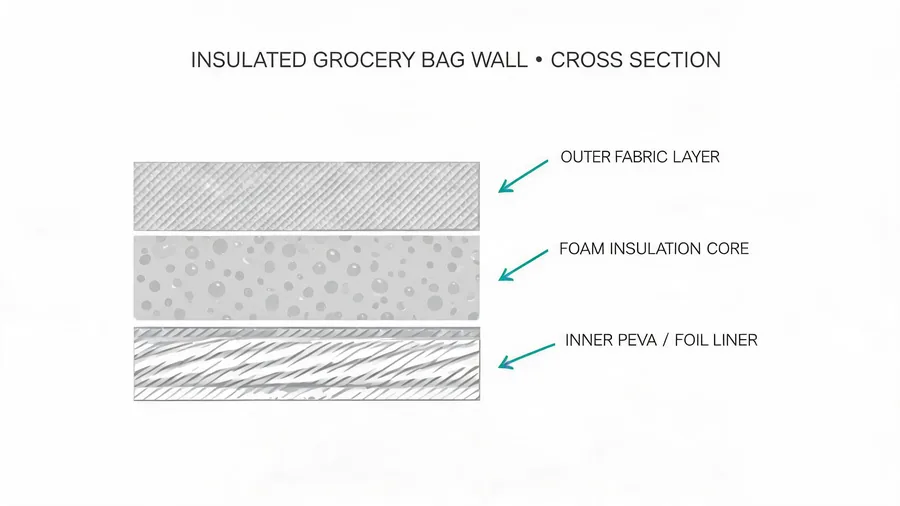
The second is 600D polyester with a closed-cell foam layer. This is the delivery bag. The outer shell resists abrasion, the foam slows conductive and convective heat transfer, and the inner liner is often a heat-welded PEVA or TPU film. Our cooler bags use closed-cell PE/XPE/EVA foam from 8 to 15 mm, with an R-value of roughly R-2.5 to R-4 per inch. An aluminum PET liner can cut radiant heat by about 50% and extend chilled holding by 10, 20%.
The functional layer stack matters. An outer shell provides abrasion resistance and printability. The insulation reduces heat transfer. A reflective barrier, when correctly positioned, reduces radiant heat. The inner liner provides cleanability and liquid containment. The closure controls air exchange. If any layer is missing or interrupted, the thermal performance drops. Thermal bridges occur where insulation is compressed, interrupted, or replaced by conductive hardware. A zipper sewn through the foam is a thermal bridge. A handle riveted through the wall is another.
Insulation thickness, cell structure, density, and continuity all influence heat-transfer resistance. A thicker foam layer helps, but only if it is continuous. A 10 mm foam with gaps at the seams performs worse than a 6 mm foam with sealed seams. Ask your supplier for the foam spec, not just the bag thickness.
Folding, stacking, and handling for checkout and delivery vans
Checkout storage is a real constraint. A grocery chain may keep hundreds of bags at each register. If the bag doesn't fold flat, it eats storage space and slows the cashier. Fold-flat construction is a requirement for most retail programmes. A bag that stands open on its own is nice to have. But it must collapse when empty.
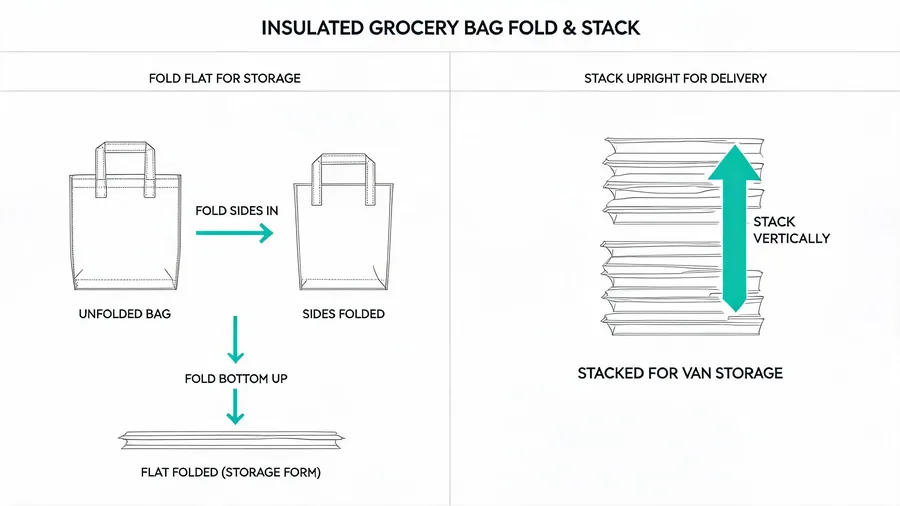
Delivery vans have a different problem. Bags are stacked in totes, on shelves, or on the floor. A bag that is too soft will collapse under the load. A bag that is too rigid won't fit odd spaces. The sweet spot is a semi-structured bag with enough body to hold its shape when loaded and enough flex to compress when empty.
Closure type drives real-use temperature loss. Opening frequency and zipper gaps can dominate temperature loss even when wall insulation is effective. A zipper seals better than an open-top tote, but it's slower. A roll-top seals well and is fast, but it requires two hands. An overlapping flap is fast but leaks air. The right closure depends on how often the bag is opened. A checkout bag is opened once. A delivery bag may be opened at every stop.
Stability on a conveyor, in a basket, and inside a delivery tote comes from the base design. A flat, reinforced base prevents tipping. A gusseted base allows the bag to stand open. A bag with no base structure will flop over and spill. This is a common failure in cheap promotional bags.
Wipe-clean liners and hygiene for grocery and delivery programmes
Grocery bags carry raw meat, dairy, produce, and frozen goods. Spills happen. A liner that cannot be wiped clean is a hygiene problem. PEVA is the standard wipe-clean liner. It's flexible, inexpensive, and can be heat-welded at the seams. TPU is more expensive but more durable and more resistant to punctures. Both are better than a bare fabric interior.
Condensation control requires a liner and seam design that can manage moisture without damaging insulation. When a cold load sits in a warm bag, condensation forms on the liner. If the seams leak, moisture reaches the foam. Wet foam loses insulating performance and can grow mold. Heat-welded seams prevent this. Sewn seams with a separate liner do not. Ask your supplier how the seams are sealed.
Wipe-clean is not machine-washable. A PEVA-lined bag can be wiped with a damp cloth. It should not go in a washing machine. The foam will break down, the liner will delaminate, and the zipper will fail. If your programme requires machine washing, you need a different product. For a guide on cleaning insulated bags properly, see how to clean an insulated bag.
Printing on the outer panel: what works for retail, delivery, and promo
Non-woven PP prints well with screen printing. It's the standard method for promotional grocery totes. The print area is large, the cost is low, and the minimum order quantity is modest. The downside is durability. Screen-printed non-woven PP fades and cracks over time. It's fine for a giveaway. It's less fine for a delivery bag that sees daily use.
600D polyester prints best with heat transfer or sublimation. The print is more durable and more detailed. It costs more and requires a higher minimum order. For delivery fleets that need brand visibility at every stop, the extra cost is usually worth it. For a promotional giveaway that will be used three times and thrown away, it is not.
Logo placement matters. At checkout, the logo faces the cashier and the customer. On the side panel, it faces the queue. In a delivery van, the logo faces the street when the driver carries the bag to the door. Think about where the bag is seen most often and place the print there. Pantone colour matching is available for single-colour prints, with a ΔE of 2.0 or better. For more on sourcing bulk insulated bags, see bulk insulated bags sourcing.
Specification fields for sourcing insulated grocery bags
A complete spec sheet prevents misquotes. Here are the fields you should fill in before you contact any supplier.
- Outer shell material: non-woven PP, 600D polyester, or another option. State the weight in g/m² or denier.
- Liner material: PEVA, TPU, or none. State the thickness.
- Foam type and thickness: PE, XPE, or EVA, in millimetres. State whether the foam is continuous or interrupted at the seams.
- Closure type: zipper, roll-top, flap, or open top.
- Capacity: in litres, with a tolerance.
- Dimensions: width, depth, and height, flat and open.
- Print method and area: screen, heat transfer, or sublimation, with the print dimensions.
- Packing: flat pack or carton pack, units per carton, carton dimensions.
Testing requirements should be written into the purchase order. Ask for a thermal test that states the ambient temperature, starting temperature, payload, refrigerant quantity, bag size, and pass criterion. Ask for a condensation test that checks for internal pooling, seam leakage, and exterior moisture. Ask for seam strength and zipper cycling tests. Do not accept a material test result as a finished-product claim. A foam sample that passes a lab test does not mean the finished bag will pass. The complete construction must be tested.
Lead time, sample policy, and MOQ should be confirmed in writing. Our standard sampling takes 1 to 10 days, and production runs 7 to 15 days for full-custom cooler bags. MOQs start at 500 pieces for cooler bags. You can reach us at [email protected].
Three programme types compared
| Programme | Typical material | Insulation level | Print method | Durability expectation |
|---|---|---|---|---|
| Checkout retail | Non-woven PP or light polyester | Thin foam or none | Screen print | Single season, occasional use |
| Home delivery | 600D polyester | 8, 15 mm closed-cell foam | Heat transfer or sublimation | Daily use, multiple years |
| Promotional giveaway | Non-woven PP | None or minimal | Screen print | Short-term, low cost |
The table is a starting point. A checkout programme for a premium grocery chain may use 600D polyester. A promotional giveaway for a cold-chain brand may include a thin foam layer. The point is to choose the material and insulation level for the use case, not for the price point alone.
For more on what an insulated bag actually is, see what is an insulated bag. For cooler backpacks as an alternative format, see insulated cooler backpacks.
FAQ
Do insulated grocery bags work?
Yes, for short transfers. An insulated grocery bag slows heat transfer, which helps keep chilled or frozen goods colder for longer than a plain tote. The effect depends on the foam layer, the liner, and how often the bag is opened. A bag with a thin foam layer and a zipper will work better than an open-top tote with no foam. But no soft-sided grocery bag will hold ice for hours like a hard cooler. The realistic use is the trip from the store or van to the refrigerator.
How long do insulated grocery bags keep things cold?
It depends on the test conditions. A cooler bag's hold time must be stated together with the ambient temperature, starting temperature, payload, refrigerant quantity, bag size, and pass criterion. Without those numbers, any claim is meaningless. In general, a well-insulated grocery bag with a zipper and a full load of pre-chilled items will hold temperature longer than a thin promotional tote. Ask the supplier for the test report, not a marketing number.
What is the difference between thermal bags and insulated bags?
In practice, the terms are used interchangeably. Both describe a soft-sided container designed to slow heat transfer and help maintain the temperature of its contents. A thermal bag may be marketed for hot or cold holding, while an insulated bag is usually associated with cold holding. The construction is the same: an outer shell, an insulation layer, and an inner liner. The difference is marketing, not engineering.
What is the best insulated bag for groceries?
There is no single best bag. The right bag depends on the programme. A checkout retail bag should fold flat, fit a shopping basket, and be inexpensive. A home delivery bag should use 600D polyester with a closed-cell foam layer and a heat-welded PEVA liner. A promotional giveaway bag should be cheap and printable. Choose the material and insulation level for the use case, not for the price point alone.