Cooler Bag Testing: The QC Checks That Matter
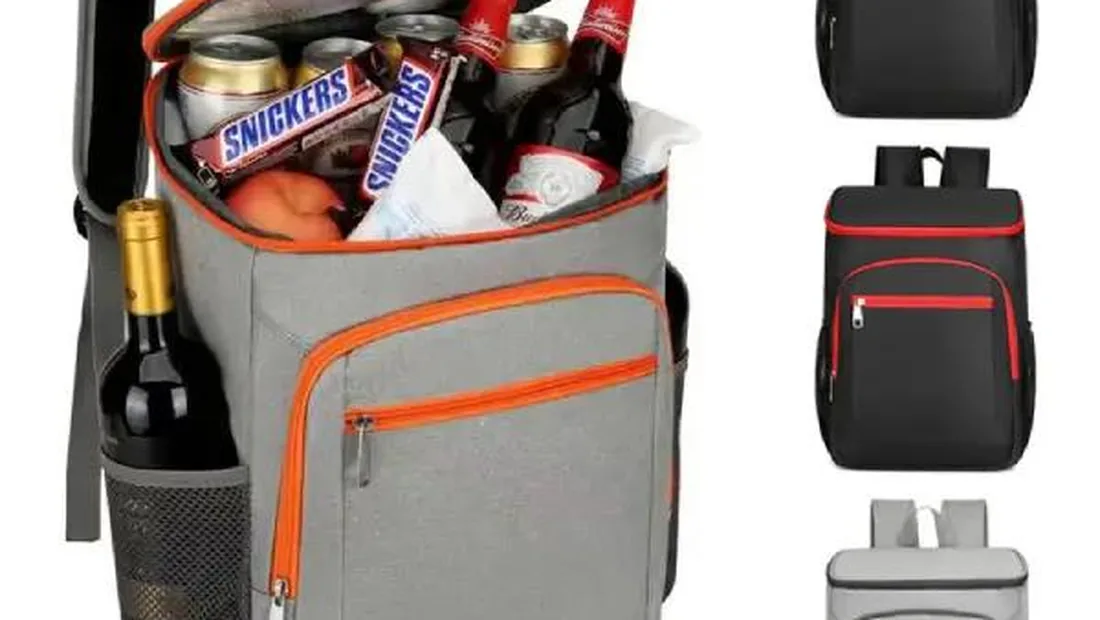
Cooler bag testing is not a single event. It is a stack of small decisions made before production, during sewing, and after the bag comes off the line. You can feel a zipper and squeeze a foam wall. What you cannot feel is whether the insulation will hold at hour six, or whether the liner will weep condensation onto a customer's food. That takes a defined test method.
Most buyers never ask for the test plan. They should. A bag that looks right in a photo can fail the first time a real payload goes inside. This guide walks through the tests that separate a dependable cooler bag from one that just looks insulated.
Material and Component Tests
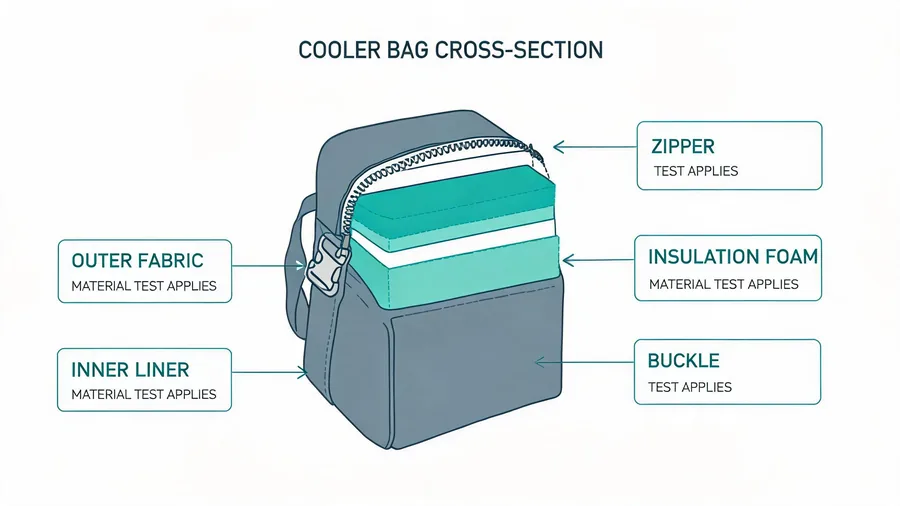
Before a single panel is cut, the raw materials get checked. Fabric, foam, film, zippers, buckles. Each one carries a failure mode.
| Test | What it catches | Why it matters for a cooler bag |
|---|---|---|
| Tensile strength | Force needed to rupture a material | A weak shell tears at a corner seam on day one |
| Tear strength | Resistance to a cut spreading | One snag on a car door should not unzip the whole panel |
| Abrasion resistance | Surface wear under repeated rubbing | Bags slide across truck beds and picnic tables |
| Seam strength | Force to break a stitched joint | The seam is usually weaker than the fabric around it |
| Colorfastness to rubbing | Color transfer under dry and wet rub | Wet hands should not come away dyed |
| Water resistance | Penetration under defined spray or pressure | Condensation and spills sit on the shell, not inside it |
| Coating adhesion | Bond between a film and its textile | A peeling liner looks cheap and traps bacteria |
| Zipper cycling | Repeated open and close durability | Cooler zippers get yanked with cold, wet fingers |
| Buckle and adjuster strength | Break strength and slippage under load | A failed buckle dumps the whole load on concrete |
| Corrosion resistance | Metal finish stability under moisture or salt | Beach trips and melted ice punish cheap hardware |
None of these tests has a universal pass number. The approved specification sets the value. A 600D polyester shell needs a different tensile threshold than a lightweight ripstop liner. What matters is that the number exists, was agreed, and was tested against the exact material lot you are buying.
Product-Level Tests for Cooler Bags
Material tests catch bad inputs. Product tests catch bad designs. A cooler bag can pass every component check and still fail as a finished item because the insulation is compressed at the seams, or the zipper gap lets warm air pour in.
Thermal Hold Test
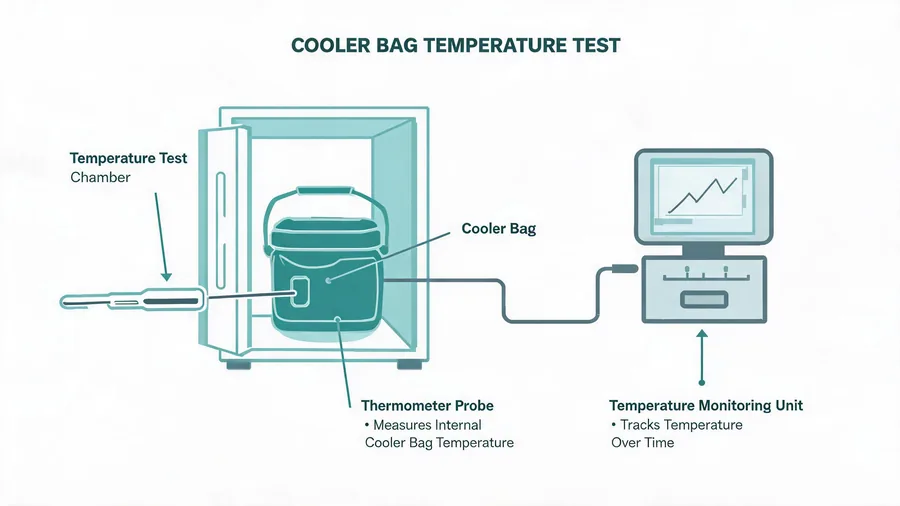
This is the one buyers ask about most. It is also the easiest to fake. A thermal hold test means conditioning the bag, the contents, and the refrigerant packs to defined starting temperatures. Then you load a stated payload, close the bag, and log internal temperature over time under a controlled ambient profile.
No shortcut works here. Pre-chilled contents last longer. A full bag holds temperature better than a half-empty one. A zipper opened three times an hour loses more cold than a zipper left closed. The test report has to state all of it: ambient temperature, starting temperature, payload, refrigerant quantity, bag size, and the pass criterion. If a supplier says "holds 24 hours" without that context, you are reading marketing, not a test result.
Condensation Test
Cold contents create moisture. The question is where that moisture goes. A condensation test loads the bag cold and then evaluates internal pooling, seam leakage, exterior moisture, and insulation damage. A liner that wets through can ruin the foam behind it. A seam that wicks moisture to the outside leaves a wet ring on the customer's car seat. Neither shows up in a photo.
Drop Test
A packed cooler bag gets dropped. From a defined height, in a defined orientation. The test looks at structural damage and whether the contents stayed protected. A bag that survives a waist-high drop onto concrete but not a shoulder-high drop onto a corner is a real design finding. The pass criterion depends on what you promised the end user.
Dimensional and Workmanship Inspection
Dimensional inspection compares the finished bag against the approved measurement method and tolerance table. A bag that is two centimeters shorter than spec changes the internal volume and the customer's perception. Workmanship inspection checks for skipped stitches, loose threads, stains, asymmetry, puckering, sharp edges, and wrong component placement. These are the defects that generate returns even when every lab test passes.
AQL Sampling and Defect Classification
You cannot test every bag. So you sample. The accepted quality limit, or AQL, sets how many units get inspected from a lot and how many defects trigger a fail. The exact sampling numbers are set in the approved specification, not guessed at the end of production.
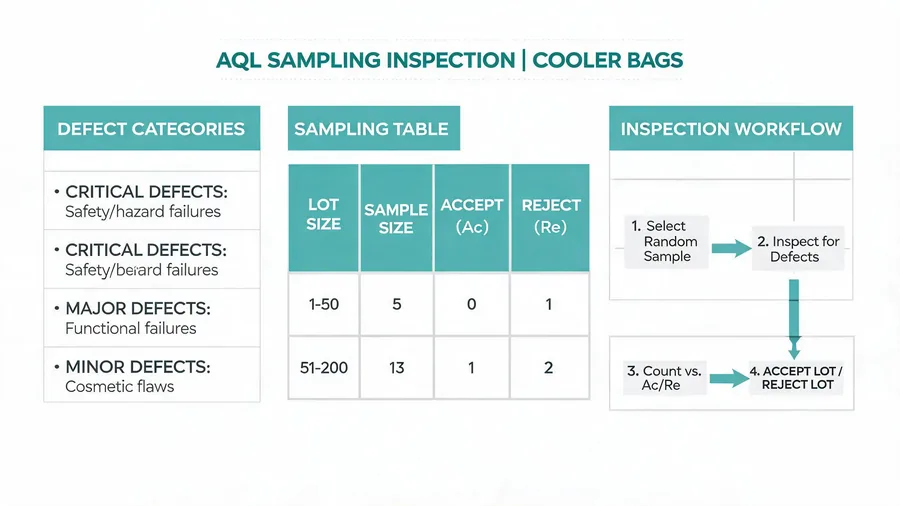
Defects get classified. A critical defect makes the bag unsafe or unusable. A major defect affects function or appearance enough that a customer would return it. A minor defect is a small imperfection that most buyers would not notice. The classifications matter because they change the AQL level applied to each category. A zipper that fails after ten cycles is major. A loose thread inside the liner is minor. A broken buckle that dumps a load is critical.
Ask your supplier for the sampling plan before production starts. Not after. A factory that cannot tell you how many bags will be inspected and against what defect list is guessing.
Claim Control: Water-Resistant, Waterproof, Leakproof
These three words are not interchangeable. And yet they get swapped constantly in cooler bag listings.
Water-resistant means the material or product passed a defined water-resistance method. The shell shrugs off light spray. It does not mean the bag can sit in a puddle.
Waterproof means the complete construction, including seams and closures, meets a stated waterproof test condition. That is a much higher bar. A waterproof zipper is expensive. A waterproof seam is a process decision, not a fabric choice.
Leakproof means the complete product passed a defined liquid-containment test. This is about what happens inside the bag. Melted ice, spilled drinks, a leaking food container. If the liner holds liquid without seepage through seams or zippers, it can be called leakproof. If only the fabric resists moisture, it cannot.
Never convert a material test result into a finished-product claim. A coated fabric that passes a lab spray test does not make the sewn bag waterproof. The seams and zipper have to pass too. And the test report has to be linked to the exact material lot, component version, sample size, and product revision. Otherwise the claim is just a word on a hang tag.
What to Ask Your Supplier
You do not need to become a lab technician. You need to ask four questions.
One: can I see the thermal hold test report with full conditions stated? Two: what is the AQL sampling plan for this order? Three: which claim, water-resistant, waterproof, or leakproof, has this exact bag passed? Four: are the test reports linked to the current material lot and product revision?
A good factory answers these without hesitation. A weak one changes the subject to price. The difference shows up six months later, in a return pile or a repeat order. That is the real cooler bag test.
You can learn more about how we build and inspect insulated bags on our OEM process page, or see specific constructions like the CB-4051 cooler backpack. For material selection guidance, start with cooler bag materials. And if you are comparing suppliers, our manufacturer comparison might help.
FAQ
What is a cooler bag thermal hold test?
It is a controlled test where the bag, contents, and refrigerant packs are conditioned to defined starting temperatures, loaded with a stated payload, closed, and logged over time under a controlled ambient profile. The report has to state ambient temperature, starting temperature, payload, refrigerant quantity, bag size, and the pass criterion. Without all of those, a hold time claim means nothing.
Is water-resistant the same as waterproof for a cooler bag?
No. Water-resistant means the material or product passed a defined water-resistance method, usually against light spray or pressure. Waterproof means the complete construction, including seams and closures, met a stated waterproof test condition. A coated fabric does not make a sewn bag waterproof.
What does AQL mean for cooler bag inspection?
AQL stands for accepted quality limit. It sets how many units from a production lot get inspected and how many defects trigger a fail. Defects are classified as critical, major, or minor, and each category can have a different AQL level. The exact sampling numbers are set in the approved specification, not guessed after production.
Which defect is worse, a broken buckle or a loose thread?
A broken buckle is worse. It is typically classified as critical because it can dump the entire load and potentially injure someone. A loose thread inside the liner is usually minor. Defect classification drives the accept or reject decision, so it has to be agreed before inspection starts.