Insulated Food Delivery Bags: Construction and Sizing
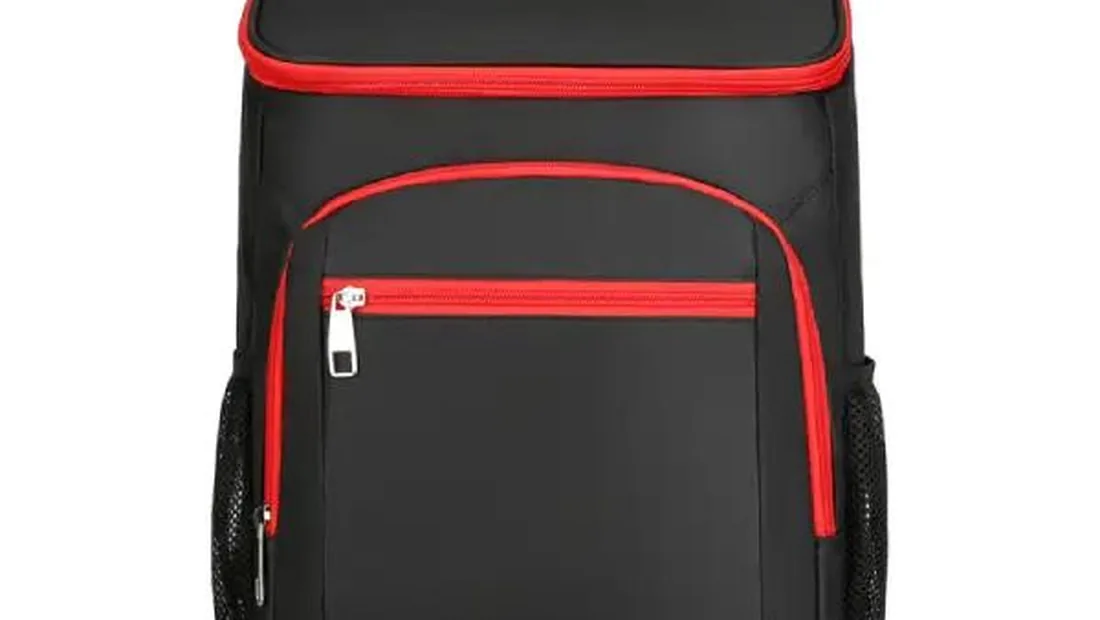
An insulated food delivery bag is not a cooler bag with a different logo. The job is different. You are moving hot pizza through rain, cold salads through summer traffic, and stacked meal boxes across town on a scooter. The bag has to hold temperature, survive being kicked around a trunk, and clean up fast enough for the next run. A buyer who specs this like a picnic cooler will replace bags within a season.
How an insulated delivery bag differs from a consumer cooler bag
Consumer cooler bags lean on foil-lined film and thin foam. They work for a trip to the park. Food delivery punishes them. The zipper gets opened forty times a night. The base scrapes against a motorbike rack. Grease soaks into the seams. A delivery bag needs closed-cell foam with real thickness, a liner you can wipe down between orders, and enough structure to stack without collapsing.
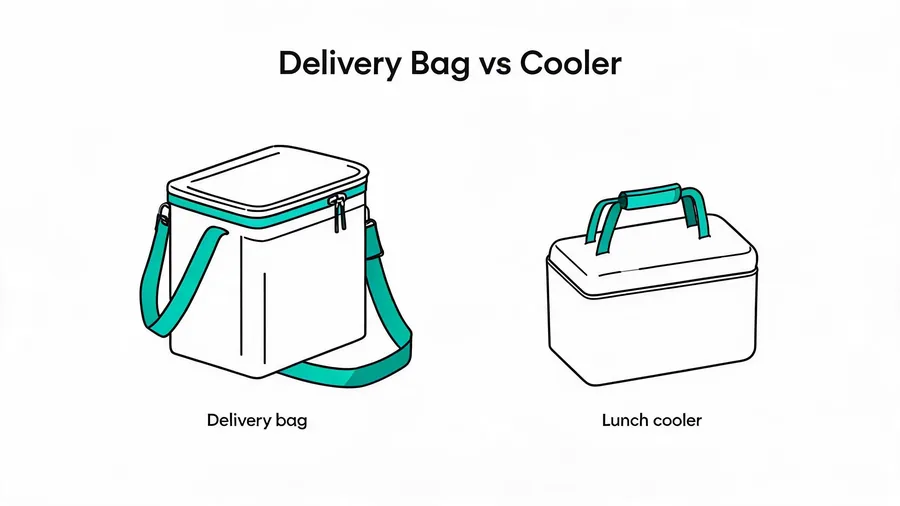
Rigidity matters more than most buyers expect. Say a courier carries three pizza boxes and a bag of salads. A floppy bag lets the boxes shift. The stack tips. Cheese slides. A semi-rigid base and side panels keep the load flat and the heat where it belongs. Foil alone cannot do that. Foam can.
Hot and cold dual compartments change the construction too. A single cavity forces you to choose. One order arrives warm, the other arrives sad. A divided insert, or two separate bags on the same rack, solves it. Specify the divider early. It affects the pattern, the zipper layout, and the cleaning routine.
Matching the bag to the delivery vehicle
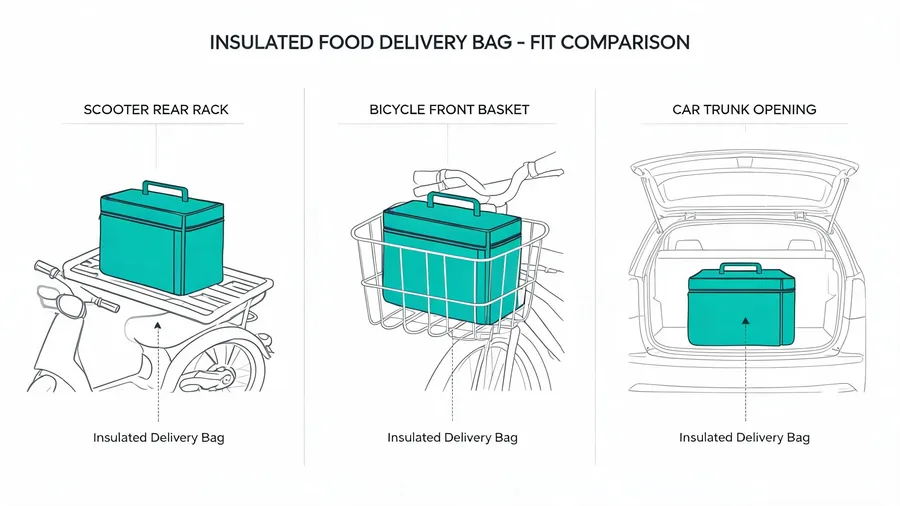
Bike and scooter couriers need backpack carry or a rack-mounted design. A top handle alone is useless at forty kilometers an hour. The bag needs a sternum strap or rack straps that keep it from swinging. Handles should sit flat when not in use. Anything that flops catches wind and rain.
Opening frequency drives temperature loss. A courier unzips the bag at every stop. Every opening exchanges air. The closure has to be fast, one-handed, and reliable. A chunky zipper with a big pull beats a fussy roll-top for hot food. Roll-tops seal better but slow down a driver who has thirty seconds at a door.
Stacking and load stability matter in vans. Catering fleets load ten or twenty bags into a cargo area. Bags that cannot hold their shape crush the ones underneath. A structured base and firm side walls let you stack three or four high. Soft bags turn into a pile of warm laundry by the third turn.
Sizing by pan and box count, not litres
Litres are a trap. Two bags can both claim twenty litres and fit completely different loads. A pizza box is flat and wide. A catering pan is deep and rectangular. A beverage carrier is tall and fragile. Buyers who size by volume end up with bags that fit nothing well.
Count the boxes. A large pizza box needs a bag that opens wide enough to slide the box in flat. Stack height tells you the depth. Three boxes, four boxes, five boxes. Each stack height changes the gusset and the zipper clearance. Specify the maximum stack you will carry, not the average.
Catering pans follow the same logic. A full-size hotel pan, a half pan, a third pan. Each has a footprint. The bag interior needs to accept the pan with a little clearance for the lid and the steam. Too tight and the liner tears. Too loose and the pan slides and dumps sauce everywhere.
Mixed compartments need their own sizing. Say a ghost kitchen packs one hot entree box and two cold side containers per order. A single large cavity lets the cold sides warm up. A divided bag with a hot side and a cold side holds the order correctly. Beverage dividers are separate. Cups are top-heavy and need their own slots or a stiff insert. Ask your supplier to quote the insert as a separate SKU. It wears out faster than the bag.
Insulation layers that actually hold temperature
Closed-cell foam is the workhorse. It resists moisture, holds structure, and slows conductive heat transfer. Thickness matters, but so does continuity. A bag with thick foam and uninsulated seams leaks heat at every stitch line. The foam has to run edge to edge, or the seams need a thermal break.
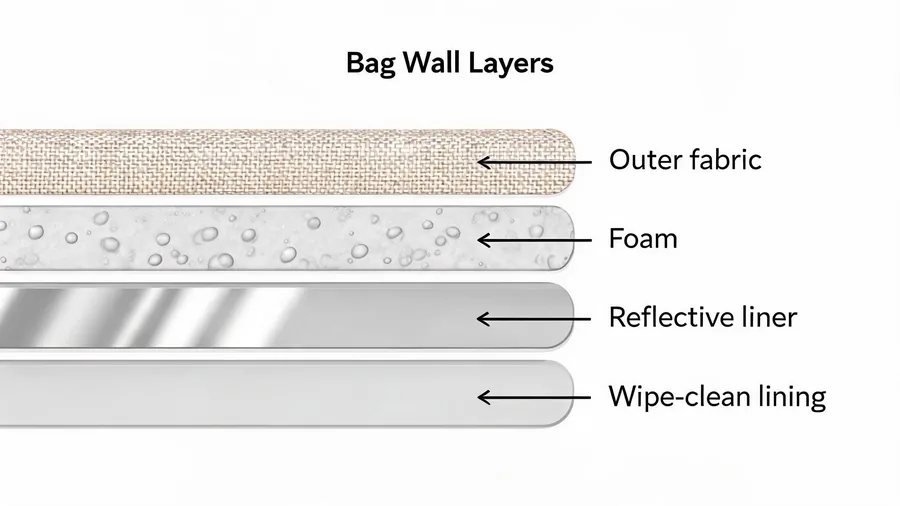
Reflective barrier placement confuses buyers. A metallized film reduces radiant heat transfer, but only when it faces an air gap. Crushed flat against the foam, it does almost nothing. In a delivery bag, the reflective layer sits inside the outer shell, facing the foam. It is not a miracle liner. It is one layer in a system.
Thermal bridges are the quiet killer. Zippers, plastic hardware, and compressed foam at the corners all conduct heat faster than the insulated panels. A metal zipper pull is a tiny radiator. Plastic pulls help. So does a zipper flap that covers the teeth. Ask where the insulation is interrupted. Every interruption is a leak.
A fuller load holds temperature better. Air heats up and cools down fast. Food and containers hold thermal mass. A half-empty bag with a small order loses heat quickly because there is not enough mass inside to stabilize the air. This is why fleet buyers should size bags to the typical order, not the largest possible one. A bag sized for six pizzas carrying one pizza is a heat sink with a zipper.
Liners and closures for food-safety cleaning
The liner is where food safety lives. It has to be non-porous, wipeable, and resistant to grease, tomato sauce, and sanitizer. Woven fabric liners look nice and fail fast. Grease soaks in, bacteria follow, and the smell never leaves. A smooth polymer film or coated fabric is the practical choice.
Condensation management is part of the liner design. Hot food releases steam. The steam condenses on the inside walls. If the liner pools water, the bag becomes a humid box. A slight slope, a drain point, or a liner that sheds moisture helps. Some fleets add a removable liner insert they can pull out and wash in a sink. That changes the quote and the replacement cycle.
Closure type controls air exchange. Zippers are fastest for hot food. Roll-tops seal better for cold items and liquids. Overlapping flaps work for catering pans but add seconds to every stop. The right closure depends on what you carry and how often the driver opens the bag. Test it with one hand, wearing gloves, in the rain. That is the real spec.
Cleanability testing is simple to describe. A supplier should be able to tell you what liner material they use and how it responds to common food residues. Ask for a sample. Rub tomato sauce into it. Wipe it with a sanitizer wipe. If it stains or absorbs, reject it. No test report replaces that five-minute check.
Comparing three delivery use cases
Different fleets need different bags. The table below separates three common profiles. It describes the size tier, insulation approach, and liner material in words, because a number without a tested method means nothing.
| Use case | Size tier | Insulation approach | Liner material |
|---|---|---|---|
| Bike courier | Compact, sized to one or two meal boxes plus a drink | Thin but continuous closed-cell foam, reflective barrier, minimal hardware to cut weight | Smooth wipe-clean film, quick to sanitize between runs |
| Catering van | Large, sized by pan count and stack height | Thicker foam, semi-rigid panels, overlapping flap or heavy zipper closure | Durable coated fabric or removable liner insert for sink washing |
| Ghost kitchen pickup | Mid-size, divided hot and cold compartments | Foam with a thermal break at the divider, separate zipper access per side | Non-porous polymer liner, condensation-shedding design |
A bike courier wants light weight and fast access. A catering van wants stackability and pan fit. A ghost kitchen wants compartment separation and a liner that survives three hundred orders a week. One bag cannot serve all three well. That is the point of the table.
Specifying a delivery bag for a fleet quote
Send a supplier a real spec, not a wish. Include the maximum box or pan count, the vehicle type, the opening frequency, and the cleaning method. That tells the factory which foam, which liner, and which closure to quote. A vague request gets a vague bag.
Material and foam terms belong in your spec. Denier and GSM describe the shell fabric. Closed-cell foam thickness and density describe the insulation. Coating weight describes the liner. You do not need to dictate values. You need to state the conditions. The supplier proposes the construction that meets them.
Testing and claim control is the part most buyers skip. A supplier who says a bag holds temperature for four hours without stating the ambient temperature, starting temperature, payload, and pass criterion is guessing. Ask for the test method. If they cannot provide one, ask for a sample and run your own test with a thermometer and a stopwatch. The bag either works on your route or it does not.
Your spec request should include the fleet size, the typical order composition, the vehicle, the cleaning process, and any branding requirements. That is enough for a competent factory to quote a real bag. If you are still comparing options, the guides on food delivery cooler bags and bulk insulated bag sourcing walk through the trade-offs in more detail. For cold-hold specifically, how to keep food cold covers the mechanics.
Send a spec and get a quote. That is the whole job.
FAQ
Does any insulated bag work for DoorDash?
No. A thin foil-lined tote will not hold temperature through a thirty-minute run in traffic. DoorDash and similar platforms care about the food arriving at a safe and acceptable temperature. A bag with continuous closed-cell foam, a wipe-clean liner, and a closure that seals properly will perform far better than a cheap promotional tote. The bag also has to survive daily use, grease, and rain.
Can delivery bags keep food cold?
Yes, if the construction is right. The same closed-cell foam that slows heat loss also slows heat gain. The reflective barrier helps against radiant heat from a hot car or direct sun. Cold hold works best when the bag is full, the contents are pre-chilled, and the bag is not opened repeatedly. A divided bag lets you carry cold items without them sitting next to hot food.
Is it worth getting an insulated bag for Uber Eats?
For a driver, yes. Hot food arrives hot, cold drinks stay cold, and customers tip better. For a fleet buyer, it is not a question of worth. It is the product. A bag that fails on a wet Tuesday night costs you a refunded order and a bad rating. A bag that works costs less than one repeat customer.
What do delivery drivers use to keep food warm?
Most experienced drivers use a structured insulated bag with closed-cell foam and a wipe-clean liner. Some add a separate thermal blanket or a hot bag insert for pizza. The best setups are sized to the actual order, so the food fills the bag and the air volume stays small. A full bag holds temperature far better than a large half-empty one.