Pizza Delivery Bags for Sale: A Buyer's Sourcing Guide
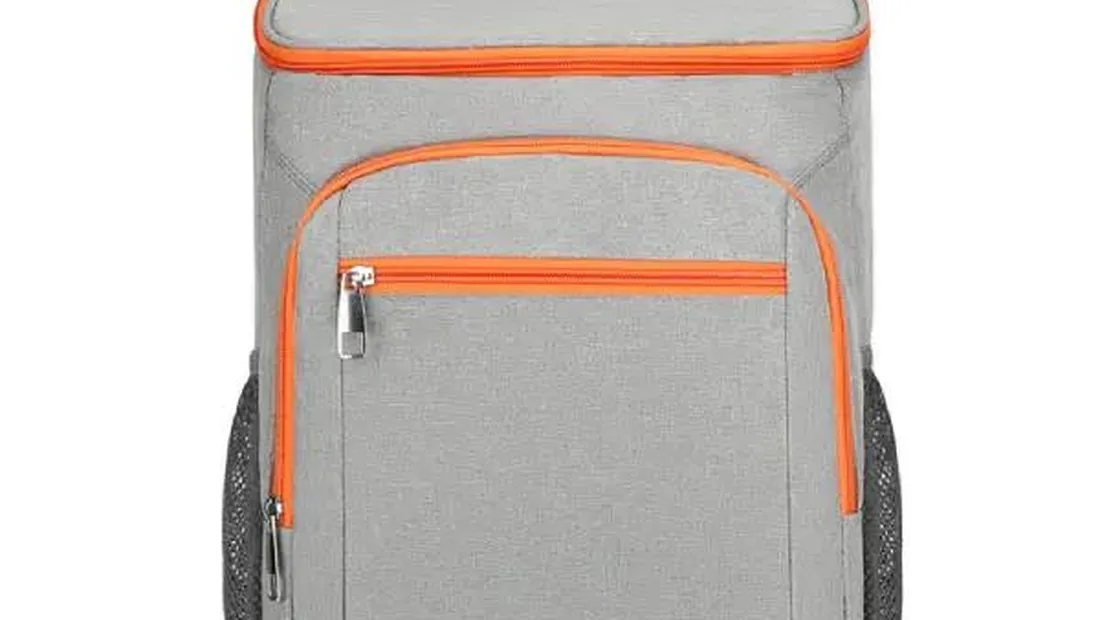
Shopping for pizza delivery bags for sale one at a time is easy. Buying them for a fleet is not. A driver can order a single bag tonight and be on the road tomorrow. A chain with forty stores needs a construction that survives a hundred runs a week, a footprint that matches its actual box sizes, and a supplier who can repeat the order next quarter without changing the foam.
That gap is where most sourcing goes wrong. This guide walks through what a commercial pizza delivery bag has to do, how to size one against a real menu, which parts fail first, and how to move from a spec sheet to an approved sample to a bulk order.
What a Commercial Pizza Delivery Bag Has to Do
A delivery bag is not a grocery cooler with a different print. Four jobs sit on it at once, and they pull against each other.
Hold heat. Manage moisture. Survive daily handling. Present the brand. That is the whole list. Miss any one and the bag either loses heat, soaks the crust, splits at a seam, or looks like a generic tote on the customer's doorstep.
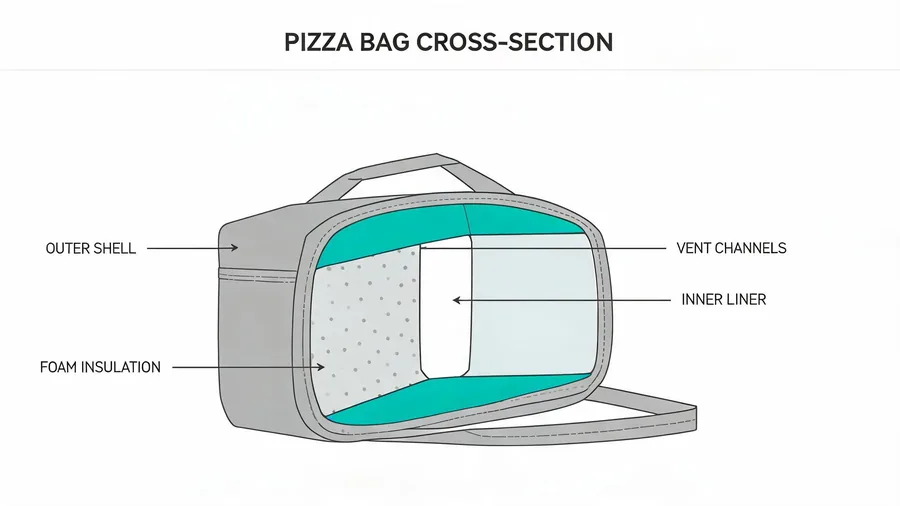
The construction is a stack of layers, and each layer has one job. The outer shell takes the abrasion and carries the print. Under it sits the insulation, usually a closed-cell foam. Then a reflective barrier: a metallized film or foil-faced layer that reduces radiant heat transfer when it is positioned correctly in the build. Inside that, the liner, which has to be cleanable and may need to contain moisture. Finally the closure, which controls air exchange at the opening.
Say a shop tries to use its existing insulated totes for pizza. The totes hold heat reasonably well. They also trap steam, and a sealed environment turns a crisp base soft within minutes. That is a moisture problem, not an insulation problem, and it is why a purpose-built bag is specified differently from a generic cooler. For background on the wider category, see the food delivery insulated bags guide.
Insulation, Liner and Venting: What Keeps a 16-Inch Pie Hot
Three variables decide how long a pie stays servable: the foam, the reflective layer, and the way moisture leaves the bag.
Foam
Closed-cell polyethylene foam, expanded polyethylene foam and EVA are the common insulation choices. Closed-cell structure matters because it absorbs almost no water, and a wet insulator stops insulating. Thickness reduces conductive heat transfer, but thickness alone is a poor headline number. Cell structure, density and continuity all influence heat-transfer resistance, and a thick panel with a compressed edge performs worse than a thinner panel that stays intact.
Reflective barrier
Aluminum or metallized PET liners cut radiant heat loss. Radiant transfer is the heat the pizza throws off that would otherwise pass straight through the wall. The barrier only helps if it faces the right way and is not creased into uselessness during folding. Placement is a construction decision, not an afterthought.
Venting and moisture
Here is the trade-off nobody puts on a product page. A fully sealed bag holds heat longer. It also holds steam, and steam is what makes a crust soggy. Some venting, or a liner that lets moisture migrate away from the pie, protects the crust at a small cost in heat retention. Which side of that trade-off you want depends on your average delivery time. Longer runs favor heat. Short runs favor crust quality.
Thermal bridges are the other quiet killer. Every zipper, handle attachment and seam interrupts the insulation and gives heat a path out. Opening frequency matters more than wall thickness in real use, because a bag that gets opened at every stop loses its advantage no matter how thick the foam is.
Any temperature claim a supplier makes should state the test method, ambient condition, starting temperature, load, refrigerant quantity and acceptance limit. If a spec sheet says "keeps hot for hours" with none of that, the number is decoration. The exact values depend on the agreed specification and the test conditions, so ask for the method, not the slogan.
Sizing a Pizza Thermal Bag for Sale to Your Menu
Size the bag to the box, not to the pizza. A 16-inch pie and an 18-inch pie do not need the same footprint, and a menu that runs both needs either two bag sizes or a bag that swallows the larger box without letting the smaller one slide around.
Interior dimensions are what matter. Exterior dimensions tell you how the bag stacks in a car; interior dimensions tell you what fits. Gusset depth controls how many pies go in a compartment, and it is the number most often left off a quote request.
Stacked loads change the math again. Two pies stacked in one compartment need vertical clearance plus a little room for the boxes to settle. Three pies need more. A bag that fits one 18-inch box snugly will not fit two stacked, and discovering that after a fleet order ships is expensive.
| Configuration | Best for | What to watch |
|---|---|---|
| Single compartment, shallow gusset | Single-pie runs, one box size | No room for a second box; check interior depth against box height |
| Single compartment, deep gusset | Stacked pies, mixed sizes | Smaller boxes slide; confirm the load does not shift in transit |
| Two compartments | Mixed orders, sides kept separate | Divided volume reduces usable depth per side |
| Bag with ticket window and shoulder strap | Fleet use, multi-drop routes | Window placement and handle drop affect how the bag rides |
Fleet usability features are worth specifying early. Handle drop decides whether a driver can carry the bag comfortably on a long walk-up. A shoulder strap helps on multi-drop routes. A ticket window keeps the order slip visible without opening the bag, which reduces opening frequency and therefore heat loss. Small features, real effect.
Zippers, Handles and Seams: The Parts That Fail First
Bags rarely fail in the middle of a panel. They fail at the opening, the corners and the handle attachments.
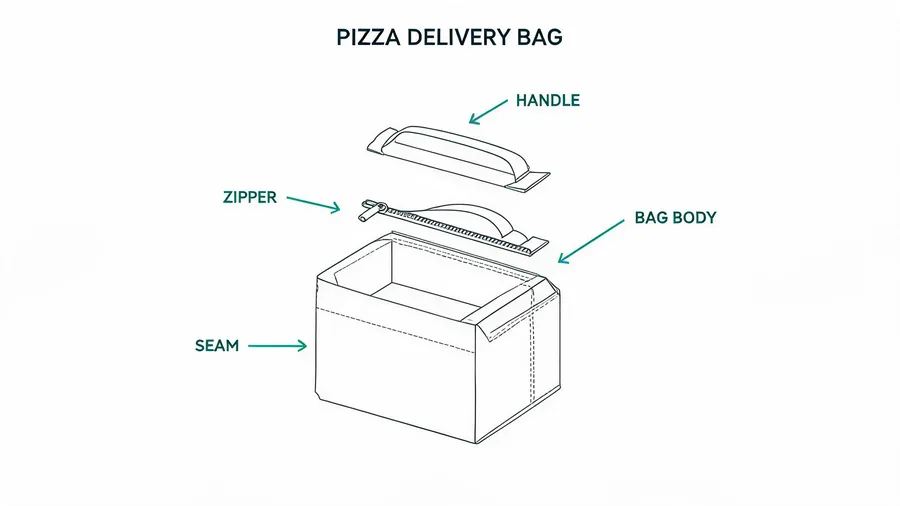
The closure is the main control on air exchange. Zipper type and flap overlap decide how much hot air escapes every time the bag opens, and a cheap zipper that jams at minus temperatures or after a hundred cycles turns a good bag into a nuisance. Look at how the flap overlaps the zipper line. A generous overlap with a proper fold does more than a heavier zipper with a thin flap.
Reinforced corners, double-row stitching and webbing handles carry the stress. The handle attachment point takes more pull force than most buyers expect, especially when a driver lifts a loaded bag by one strap. A reinforcement patch at that junction is cheap to add at the sample stage and impossible to add later.
Seams behave differently around moisture. Heat-welded seams can give a cleaner moisture barrier because there are no stitch holes. Stitched seams are more repairable and often stronger in tension, but the needle holes are paths for water unless the construction accounts for them. Neither is universally better. Match the seam to the liner and the cleaning method.
Before committing to a fleet order, inspect a sample for the things that fail: zipper action after repeated open and close, stitching at the corners, handle attachment under load, liner adhesion, and whether the foam stays put when the bag is folded flat. If a sample survives a week of real routes, the design is probably sound. If it does not, no spec sheet will save it.
How to Buy Commercial Pizza Delivery Bags in Quantity
Two paths exist. Stock bags and OEM or private-label bags.
Stock bags make sense when you need volume fast and a standard size fits your menu. You take the supplier's existing construction, add a logo if the supplier offers it, and ship. The trade-off is that you inherit someone else's sizing, foam choice and liner, and those may not match your boxes.
OEM makes sense when the bag is part of the brand or when standard sizes do not fit. You control dimensions, foam thickness, liner, closure, fabric, logo placement and packaging. You also take on sampling and revision rounds, which is the normal path from spec to approved unit. Expect at least one revision cycle. Plan for it rather than treating it as a delay.
Unit price depends on fabric weight, foam thickness, liner, logo process and packing. Not on bag size alone. A buyer comparing two quotes for "a 16-inch pizza bag" may be comparing two entirely different constructions, which is why the spec sheet matters more than the number at the bottom. For the full ordering sequence, see the OEM process.
This is also why published pizza delivery bag price figures are rare and often useless. There is no single price for a category. There is a price for a specific construction at a specific quantity with a specific logo process and packing method.
Spec Sheet Checklist Before You Request a Quote
Send this and you will get comparable quotes back. Skip it and you will get guesses.
- Dimensions with measurement points and tolerances. Height, width, depth, opening length, gusset depth. Not "fits a 16-inch pizza."
- Material composition. Shell fabric type and weight, foam type and thickness, liner type, coating or lamination.
- Closure and construction. Zipper type, flap overlap, seam type, reinforcement locations, pocket and divider layout.
- Logo artwork. Placement coordinates, process, colors and the durability requirement.
- Packing and shipping. Packing method, carton quantity, carton marks, shipping test expectations.
- Intended use and load. How many pies, what box sizes, what average route length.
A spec written this way lets a supplier quote against the same target you are measuring. It also protects you at inspection, because acceptance limits are defined before production starts rather than argued about afterward.
Fabric options across the category include nylon at 110 to 160, 180 to 220 and 240 to 280 gsm, polyester at 190T through 1200D, canvas at 8 to 15 oz, and recycled PET where a sustainability story matters. The right weight depends on how hard the bag gets used, not on a default. For adjacent product lines, the food delivery cooler bags range covers related constructions.
Common Questions From Fleet Buyers
Who actually manufactures pizza delivery bags? Some sellers run their own production. Others resell. Ask any supplier whether they own the factory, who makes the foam, and whether they can repeat the exact construction on a reorder. If the answer is vague, the second order will differ from the first.
Does a branded delivery bag have to work with a delivery platform? Platforms set their own equipment expectations, and those change. Check current platform guidance directly rather than assuming a bag that worked last year still qualifies.
How should a buyer think about pizza delivery bag price when nothing is published? Compare constructions, not headlines. Ask each supplier to quote the same spec sheet, then compare what is inside the quote: fabric weight, foam thickness, liner, logo process, packing. That comparison is the only one that means anything.
Where does a spec go? To a supplier who will answer construction questions in writing. Send the checklist above and ask for a sample. If you want to see how the sampling and revision cycle runs, start with the contact page and send your spec for a quote.
FAQ
Who sells pizza delivery bags?
Both manufacturers and resellers do. The difference shows up on the second order. A manufacturer can repeat the exact foam, liner and stitch pattern you approved. A reseller may source from a different factory next quarter and send you a bag that looks similar and performs differently. Ask who owns the production line before you commit to a fleet quantity.
Is it worth buying a pizza bag for delivery work?
It depends on your route length and your menu. A bag that holds heat and manages moisture protects the product, and a soggy or lukewarm pie costs you repeat orders. If your average run is short and your volume is low, a single stock bag may be enough. If you run multi-drop routes or ship branded packaging, the construction matters enough to specify properly.
What should a pizza delivery bag spec sheet include?
Dimensions with measurement points and tolerances, shell fabric type and weight, foam type and thickness, liner type, closure and flap construction, reinforcement locations, logo artwork with placement and process, packing method, carton quantity and shipping test expectations. Add intended use, box sizes and average route length so the supplier can quote against your real conditions.
How do you compare pizza delivery bag quotes without published prices?
Send the same spec sheet to every supplier and compare what comes back line by line. Fabric weight, foam thickness, liner type, logo process and packing all move the number, so two quotes for a bag that fits a 16-inch box may describe two different products. The comparable quote is the one that names its construction.