What Is an Insulated Bag and How Does It Actually Work?
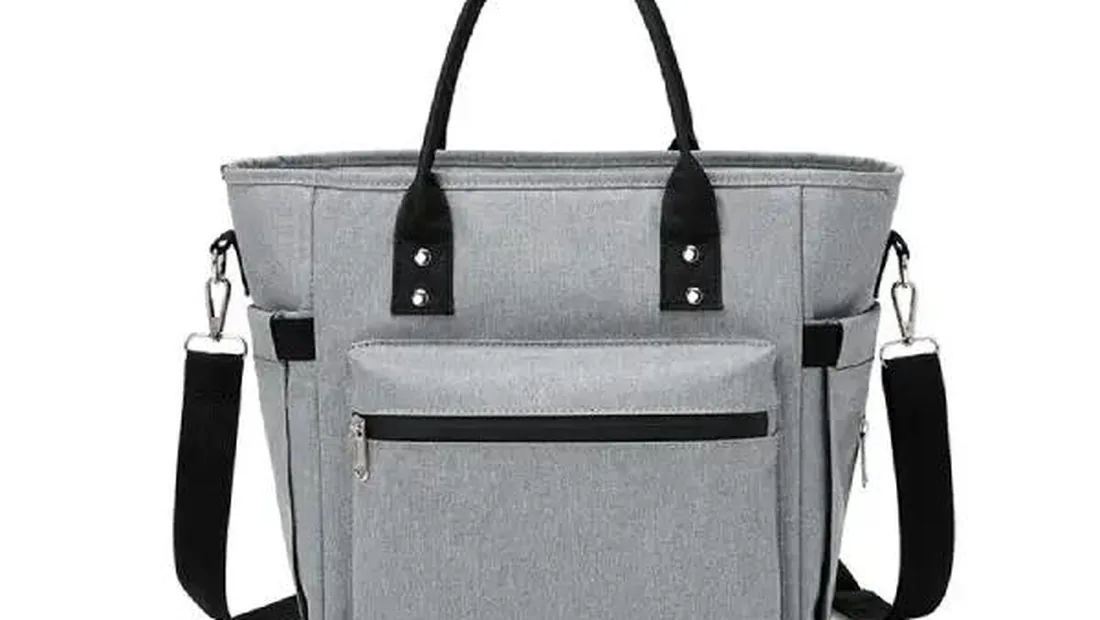
An insulated bag is a soft container built to slow heat transfer between its inside and the outside world. It keeps cold things cold for a while. It keeps warm things warm for a while. It doesn't create cold and it doesn't create heat. What is an insulated bag in practical terms? It's a barrier system with a specific layer stack. The quality of that stack decides how long your contents hold their temperature.
Most people think the insulation is the whole story. It isn't. The outer shell, the inner liner, the closure, and even the way the bag is loaded all change the result. A buyer ordering 800 units in three colors needs to know this before locking a specification. Two bags can look identical on a product page and perform very differently in a cooler test.
The Functional Layer Stack
A cooler bag is not one material. It's a sequence of layers, each with one job. Miss one layer and the bag still looks fine. It just stops working as well.
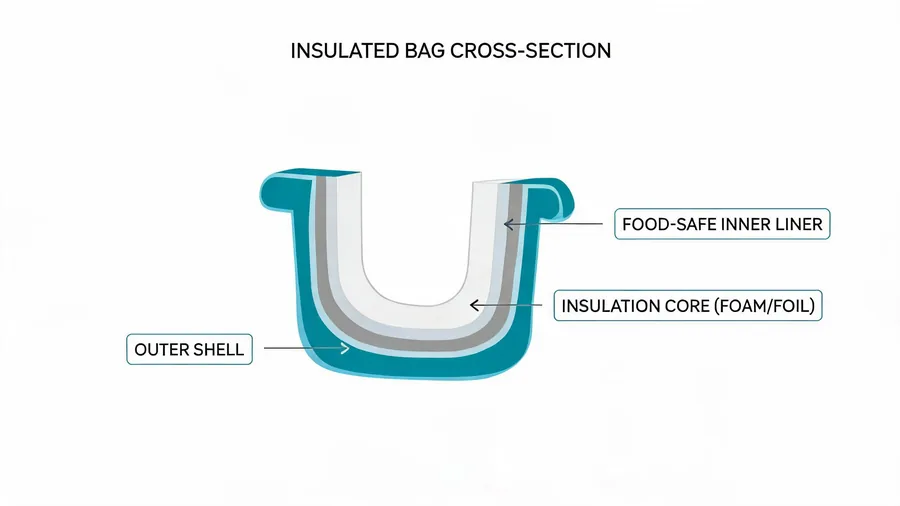
| Layer | Primary function | What happens if it's weak |
|---|---|---|
| Outer shell | Abrasion resistance, appearance, printability, initial weather protection | Scuffs, tears, and a bag that looks worn after one season |
| Insulation | Reduces conductive and convective heat transfer | Rapid temperature equalization with the room |
| Reflective barrier | Reduces radiant heat transfer when positioned correctly | More heat gain on sunny days, less stable internal temperature |
| Inner liner | Cleanable interior, moisture resistance, liquid containment | Leaks, mold risk, and a liner that's hard to wipe clean |
| Closure system | Controls air exchange at the opening | Warm air enters every time the zipper gap opens |
| Refrigerant pack | Absorbs heat as the cooling medium warms or changes phase | Shorter hold time, warmer contents |
That table is the whole game. Six layers. Each one either blocks a heat path or supplies the cooling load.
The Three Heat Paths
Heat moves three ways: conduction, convection, and radiation. An insulated bag has to deal with all three. They never take turns. They happen at once.
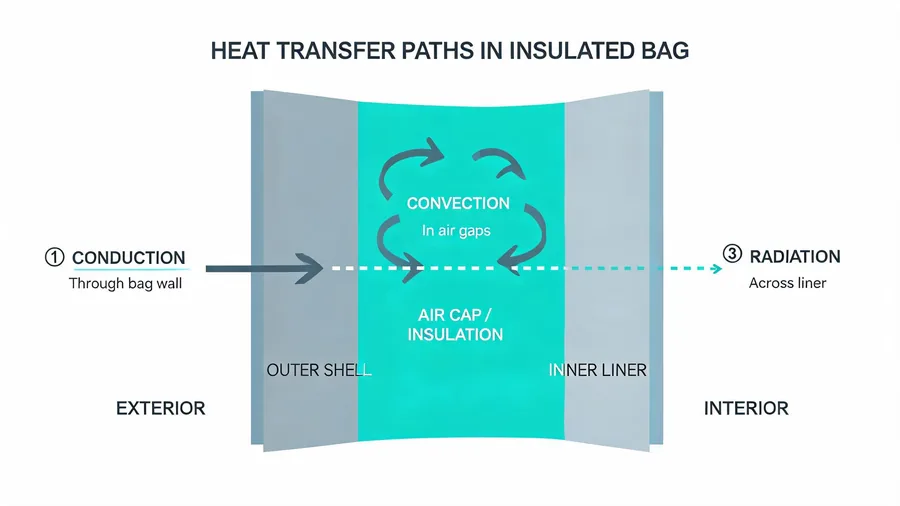
Conduction is heat moving through solid contact. The bag wall touches warm air outside and cool air inside. The insulation layer slows that. Convection is heat carried by moving air or liquid. Every time you open the bag, warm air rolls in. Radiation is heat moving as infrared energy. Think sunlight hitting the bag's outer surface. The reflective barrier addresses that path.
Here's the part that trips people up. The insulation layer does nothing for convection at the opening. The reflective barrier does nothing for conduction through the wall. Each layer has a lane. If a spec sheet only calls out insulation thickness and ignores the closure design, the bag will underperform in the real world. Even a thick wall won't save it.
Say a buyer tests two bags side by side. Bag A has 12 mm of closed-cell foam in the walls. Bag B has 8 mm plus a properly positioned reflective liner and a better zipper. In a lab test with the bags sealed and never opened, Bag A might win on wall performance. In a real lunch run where the bag gets opened six times, Bag B often holds temperature longer. The opening dominates.
Thermal Bridges and Why They Matter
A thermal bridge is any spot where heat gets a shortcut through the wall. It happens where insulation is compressed, interrupted, or replaced by hardware.
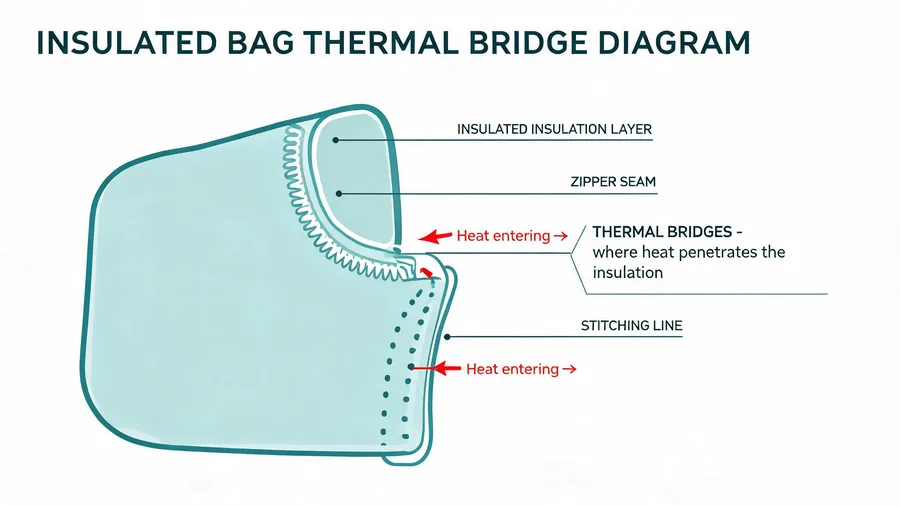
Stitch lines are the classic example. The needle punches through the foam. The thread creates a path from the outer shell to the inner liner. A bag with dense quilting looks premium and leaks heat at every stitch. Hardware does the same. A metal D-ring sewn through the wall conducts heat far better than the foam around it.
Designers reduce thermal bridges by avoiding full-thickness stitching through the insulation. They isolate hardware on webbing tabs. They keep the insulation layer continuous across the base and side panels. You can't eliminate every bridge. You can manage where they sit and how many there are.
Imagine a seam running straight across the front panel with no foam behind it. That seam is a highway for heat. Now imagine the same bag with the seam moved to the edge, where the front and side panels meet. The bridge is still there, but it's shorter and less exposed. That's the kind of decision that separates a working cooler bag from a decorative one.
Why a Full Bag Holds Temperature Better
A smaller air volume means less rapid internal temperature fluctuation. That's not marketing language. It's basic thermal behavior. Air changes temperature quickly. A cold drink changes temperature slowly. So a bag packed full of cold cans and food has less air to warm up. The contents themselves act as additional thermal mass.
A half-empty bag has a big air pocket at the top. Every time the zipper opens, that warm air rushes in and the cold air spills out. The bag then has to cool the new air using the cold contents and the refrigerant pack. That's wasted cooling capacity.
This is why the best cooler bag advice for end users is simple: fill the bag. Pre-chill the contents. Use a correctly conditioned refrigerant pack. A full bag with pre-chilled contents will outperform a half-empty bag with warm cans every single time. Even if the bag itself is identical.
Conditioning and Hold-Time Claims
Conditioning means bringing the bag, the contents, and the refrigerant packs to specified starting temperatures before testing. You don't test a cooler bag by throwing warm cans into a room-temperature bag and starting the clock. That test tells you almost nothing useful.
A proper test states the ambient temperature. It states the starting temperature of the contents, the load, the refrigerant quantity, and the acceptance limit. Then it measures hold time. That's the period during which the contents stay within a defined temperature range under those stated conditions.
This is why any hold-time claim without test conditions is meaningless. A bag that holds 8 hours in a 20°C office may hold 3 hours in a 35°C car trunk. Same bag. Different result. The bag didn't change. The test did.
So when a supplier says "12-hour cooler bag," ask one question: under what conditions? If they can't answer, they're guessing. A supplier who can answer has done the work. The answer should include ambient, starting temperature, load type, refrigerant pack spec, and the temperature limit that defines the end of the hold.
Temperature excursions happen when the measured temperature moves outside the approved range. A thermal profile is the time-based record of those temperatures. Buyers who care about performance ask for the thermal profile, not just the headline number.
Closure Systems and Real-Use Performance
Zippers, roll-top closures, and overlapping flaps have different sealing performance. A zipper is convenient but creates a gap at the slider and along the teeth. A roll-top closure seals more completely but is slower to open and close. An overlapping flap without a zipper is the easiest to use and the least airtight.
Opening frequency dominates real-use temperature loss. Every open cycle exchanges air. The best-insulated wall in the world can't fix a bag that gets opened every ten minutes. This is why lunch bags and breast milk cooler bags need different design priorities than a camping cooler that stays closed for hours.
Our insulated cooler backpacks page covers how closure and carry design work together for active use. For a specific application with very different closure demands, see insulated cooler bags for breast milk. And if you want to understand how these design decisions get made in production, the OEM process page walks through the steps.
Choosing a Bag That Actually Works
You don't need to be a thermal engineer to buy a good insulated bag. You need to ask the right questions and recognize a vague answer when you hear one.
Ask about the insulation type and thickness. Ask whether the reflective layer is positioned correctly in the stack, not just whether it exists. Ask about the closure design and how it's tested. Ask for the hold-time test conditions, not just the hold-time number. Ask about thermal bridges at the seams and hardware points.
A buyer who orders 500 units without asking these questions is buying a shape, not a performance spec. The shape will arrive. The performance may not. That's a costly way to learn a lesson that the spec sheet could have taught you in an afternoon.
Ready to talk specifications? Start at our contact page or review a specific cooler bag build to see how these layers come together in a real product.
FAQ
What is an insulated bag made of?
It's made of a layer stack: an outer shell for abrasion and appearance, a closed-cell foam or similar insulation layer to slow conduction, a reflective barrier to reduce radiant heat, an inner liner for cleanability and moisture resistance, a closure system to control air exchange, and optionally a refrigerant pack to supply cooling.
How long does an insulated bag keep food cold?
It depends on the test conditions. Ambient temperature, starting temperature of the contents, load, refrigerant pack quantity, and the acceptance limit all change the result. A bag that holds 8 hours in a 20°C office may hold 3 hours in a 35°C car. Ask the supplier for the hold-time test conditions, not just a number.
Why does my insulated bag not stay cold when it's half empty?
A half-empty bag has a large air pocket. Air changes temperature quickly, and every time you open the zipper, warm air rushes in and cold air spills out. A full bag with pre-chilled contents has less air to warm and more thermal mass to hold the temperature steady.
Is a thicker insulated bag always better?
Not necessarily. Insulation thickness matters, but thermal bridges at stitch lines and hardware, the quality of the closure system, and the position of the reflective barrier all affect performance. A thinner bag with a better closure and fewer thermal bridges can outperform a thicker bag that gets opened frequently.