Insulated Tote Bag: Construction, Foam and Liner Guide
An insulated tote bag looks simple from the outside. It's a soft-sided carrier with a thermal layer inside. Buyers who treat it as a commodity usually end up reworking the spec. The construction choices are small in number. But they decide whether the tote works for a grocery route or fails on the first warm afternoon.
This guide walks through the layers, the closures and the spec points that matter when you order insulated totes in bulk. No brand stories. No hour claims. Just the mechanics.
How an insulated tote is built from the outside in
Most insulated totes follow the same layer stack. The outer shell gives the bag its structure, print surface and first line of weather protection. Polyester is the most common choice because it prints well and holds shape. Nylon is lighter and stronger for its weight. Canvas gives a firmer hand feel and a more premium look. Recycled polyester, often called rPET, is available for buyers whose retail programme needs a recycled-content story.
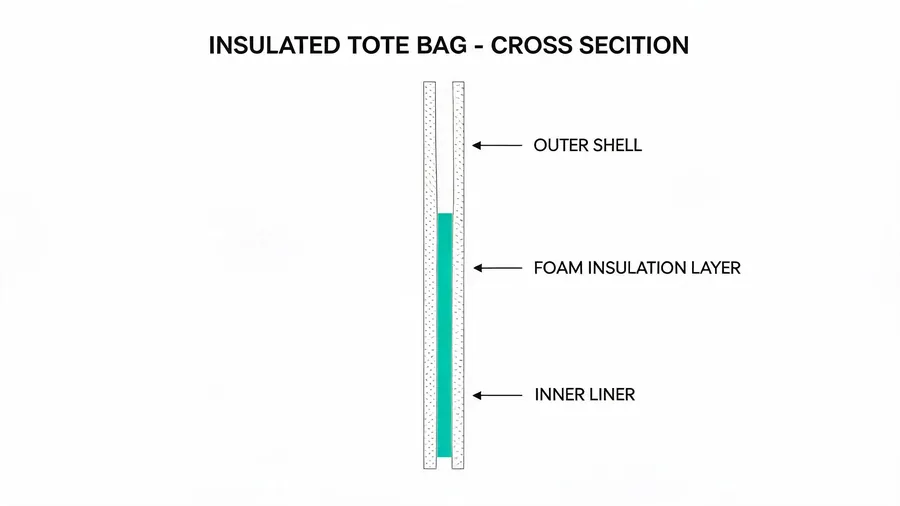
Under the shell sits the insulation. Closed-cell foam is the standard. It resists moisture and provides thermal resistance without collapsing when the bag is squeezed. Polyethylene foam, expanded polyethylene and EVA all appear in this role. The foam layer is the main barrier against conductive heat moving from the outside air to the contents.
Next comes the reflective barrier. A metallized film, usually aluminum on a PET carrier, faces the interior. It reduces radiant heat transfer when positioned correctly. This layer does not create cold. It reflects some of the heat that would otherwise enter through the walls.
The inner liner is the layer the user touches. PEVA and aluminum PET are common. The liner must be cleanable and should resist moisture. In a leak-prone use case, like carrying chilled drinks, the liner choice matters as much as the foam.
Seams come last. Heat-welded seams outperform stitched seams on leak resistance. A stitched seam leaves needle holes. A welded seam fuses the liner layers together. For totes that will carry ice or condensation, welded seams are worth the extra tooling cost.
What actually drives hold time
Hold time is not a single number. It's a result that depends on the test method, the ambient temperature, the starting temperature of the contents, the load and the refrigerant. Any supplier who quotes an hour figure without those conditions is guessing.
Four factors do the real work. First, the insulation layer. Thicker foam with a consistent cell structure resists heat transfer better than thin or compressed foam. Continuity matters too. If the foam is crushed at the corners or interrupted by hardware, heat finds those weak points. A thermal bridge is any place where insulation is compressed or replaced by something conductive.
Second, the reflective liner. Its position determines whether it helps. The metallized surface must face the interior, not the shell. When it does, it cuts a meaningful share of radiant heat. The effect is real but it's not a substitute for foam.
Third, the closure. Opening frequency and zipper gaps dominate real-use temperature loss. A tote with excellent walls and a loose lid will lose more cold air through the opening than through the foam. The seal is the cheapest performance upgrade a buyer can specify.
Fourth, pre-chilling. Cold contents and conditioned refrigerant packs extend hold time far more than any liner upgrade. This is a user behavior, not a construction feature. But a buyer who sells into delivery programmes should know it, because the end user's habits will decide whether the bag performs as promised.
Say a grocery chain specs a tote with premium foam. The delivery driver leaves it open between stops. The foam does not matter. The opening does.
Open-top, zip-top and flip-lid totes compared
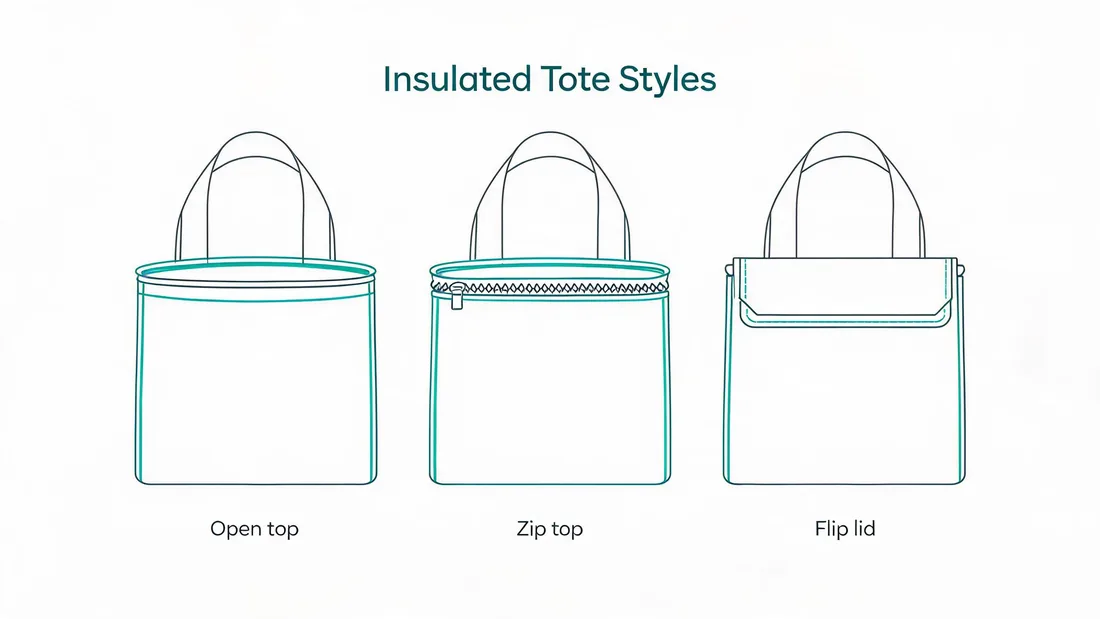
Three closure styles cover most insulated tote programmes. Each one trades access speed against seal quality.
An open-top tote has no closure over the main compartment. Access is instant. The user reaches in and grabs. The trade-off is air exchange. Warm air enters freely. Open-top totes work best in retail settings where the bag is a shopping carrier and the cold contents are only in transit for a short time.
A zip-top tote closes with a zipper across the main opening. This controls air exchange far better than an open top. The zipper is not airtight, but it limits convection. Zip-top totes suit delivery programmes where the bag sits in a vehicle and is opened at each stop. Each opening costs cold air, but between stops the seal holds.
A flip-lid tote uses an overlapping flap that folds over the opening. It balances access and seal. The flap is faster to open than a zipper and more resistant to air movement than an open top. Flip-lid designs appear in meal-kit and catering programmes where the user needs one-handed access but still wants some thermal protection.
Imagine a meal-kit brand that ships chilled ingredients in a tote. The customer opens the bag once at home. A zip-top is fine. Now imagine a grocery delivery driver who opens the bag at every stop. The zipper slows the route. An open-top is faster but loses performance. The flip-lid is often the compromise.
| Closure | Access speed | Seal quality | Best use |
|---|---|---|---|
| Open-top | Fastest | Lowest | Retail shopping totes, short cold-hold needs |
| Zip-top | Moderate | Best | Delivery programmes, repeat stops, longer routes |
| Flip-lid | Fast | Moderate | Meal kits, catering, one-handed access |
Construction levels: foam, liner, closure and best use
Most insulated totes fall into three construction bands. The bands are not fixed tiers. They're a way to think about what the buyer is actually paying for.
Entry level. Thinner foam, a basic PEVA liner, and an open top. This tote keeps a cold item cool for a short errand. It's a retail giveaway or a low-cost grocery carrier. The material cost is low and the performance ceiling is low.
Mid level. A closed-cell foam layer in the typical working range, an aluminum PET liner, and a zip-top closure. This is the workhorse for delivery programmes. The liner reflects radiant heat, the foam provides the main resistance, and the zipper limits air exchange between stops.
Premium level. Thicker foam, welded seams, and a waterproof zipper or roll-top. This tote is built for condensation, ice packs, and repeated wet loads. The welded seams prevent leaks. The closure controls both air and liquid. Buyers who need this level are usually shipping temperature-sensitive goods, not groceries.
| Level | Foam | Liner | Closure | Best use |
|---|---|---|---|---|
| Entry | Thin closed-cell | Basic PEVA | Open-top | Short errands, retail carryout |
| Mid | Standard closed-cell | Aluminum PET | Zip-top | Delivery routes, grocery programmes |
| Premium | Thick closed-cell | Welded PEVA or PET | Waterproof zipper or roll-top | Wet loads, ice, temperature-sensitive goods |
Leak resistance and seam treatment
Condensation is the enemy of insulation. When warm air meets a cold liner, moisture forms. If the seams leak, that moisture soaks into the foam. Wet foam loses thermal resistance and can develop odor or mold. A leak-resistant tote is not just about keeping liquid in. It's about keeping the insulation dry.
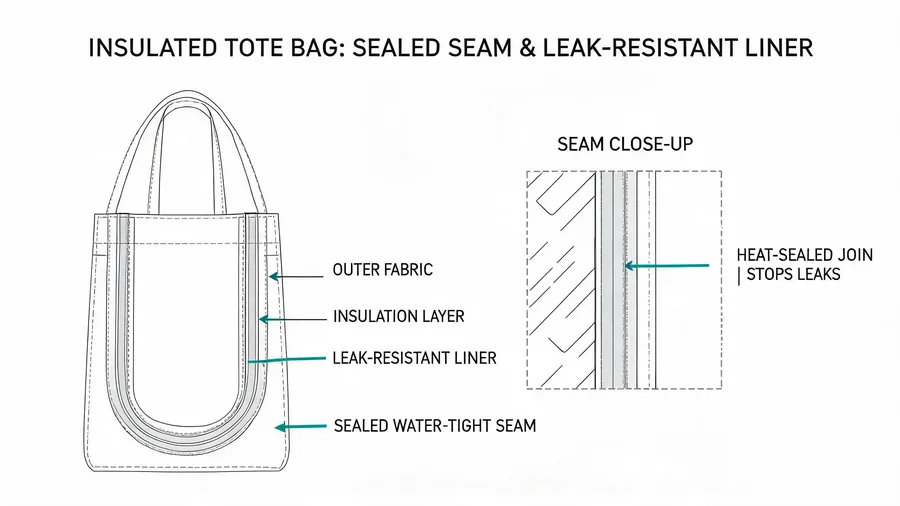
Stitched seams are the cheapest option. They also leak. Every needle hole is a path for water. A stitched seam can be taped or sealed, but the stitch line remains a weak point.
Heat-welded seams fuse the liner material together. No needle holes. No thread. The seam becomes a continuous barrier. Welded seams cost more because they require different tooling and often a different liner material. For totes that will carry ice or chilled drinks, the upgrade pays for itself in fewer returns.
Coatings add another layer of protection. A polyurethane or PVC coating on the shell fabric improves water resistance on the outside. A TPU lamination on the liner creates a waterproof interior. Waterproof zippers and roll-top closures complete the system. The goal is a tote that can handle condensation without letting it reach the foam.
Condensation control starts with the liner and seam design. A liner that can manage moisture without damaging the insulation is the difference between a tote that lasts one season and one that lasts five.
Spec points to send for a quote
Buyers who send a complete spec get better quotes. Buyers who send a photo and a target price get whatever the supplier already makes. Here is the list that separates the two.
- Product name and intended use. State whether the tote is for retail, grocery delivery, meal kits or catering.
- Target user and maximum recommended load. A tote for a driver carrying six chilled meals is not the same as a tote for a shopper carrying two.
- Size, capacity and dimension diagram. Include measurement points and tolerances.
- Material composition. Outer shell fabric, foam type and thickness, liner material, coating and finish.
- Closure type. Open-top, zip-top or flip-lid. If zipper, specify the zipper length and whether it is waterproof.
- Handle drop and base board. These affect how the tote feels in the hand and whether it stands up when loaded.
- Artwork, label content and placement. Include color references and durability requirements.
- Packing method and carton quantity. Specify polybag requirements and any shape-control inserts.
- Test method and acceptance limits. State the conditioning, ambient conditions, load and refrigerant quantity for any thermal performance claim.
That last point is the one most buyers skip. It's also the one that separates a real performance spec from a marketing claim. If the supplier cannot state the test method, the hold time number means nothing.
For more on how insulated bags work as a category, see what an insulated bag actually is. For a broader look at sourcing in volume, read bulk insulated bag sourcing. If you're comparing totes against other form factors, insulated cooler backpacks covers the backpack side. And if your programme involves cleaning and reuse, how to clean an insulated bag is worth a look.
Send your spec with the points above. A quote that starts from a complete spec is faster and closer to the final product.
FAQ
Do insulated tote bags work?
Yes, when the construction matches the use. An insulated tote slows heat transfer through the walls and reduces air exchange at the opening. It works best with pre-chilled contents and a conditioned refrigerant pack. It does not create cold. A tote with thin foam and an open top will not hold temperature as long as one with thicker foam and a sealed closure.
What is the difference between thermal bags and insulated bags?
The terms overlap in practice. An insulated bag uses a low-conductivity layer, usually closed-cell foam, to slow heat transfer. A thermal bag is a broader term that may include a reflective liner or a phase-change material. In bag manufacturing, insulated refers to the foam layer. Thermal often refers to the reflective or heat-managing components. Buyers should ask which layers are actually specified.
What is the best insulated tote bag for grocery delivery programmes?
A zip-top tote with standard closed-cell foam and an aluminum PET liner is the common choice. The zipper limits air exchange between stops. The foam provides the main thermal resistance. The reflective liner reduces radiant heat. The exact spec depends on route length, load and how often the driver opens the bag.
How thick should the foam be in an insulated tote bag?
There is no single correct thickness. The foam thickness should be chosen with the liner, closure and expected hold time. Thicker foam generally resists heat transfer better, but only if it is continuous and not compressed at the corners. The right thickness is the one that meets the performance spec under stated test conditions.