Wholesale Lunch Bags: Insulation, Liners and Bulk Specs
You need a wholesale lunch bag that survives a school year, a warehouse shift, or a corporate wellness rollout. The format you pick decides almost everything else: how the food goes in, how the bag carries, how long it holds temperature, and what you can print on it. Get the format wrong and no amount of premium fabric fixes it.
Here is what actually changes between a soft insulated lunch bag, a lunch tote and a lunch box carrier, and what to put in the spec before you ask anyone for a quote.
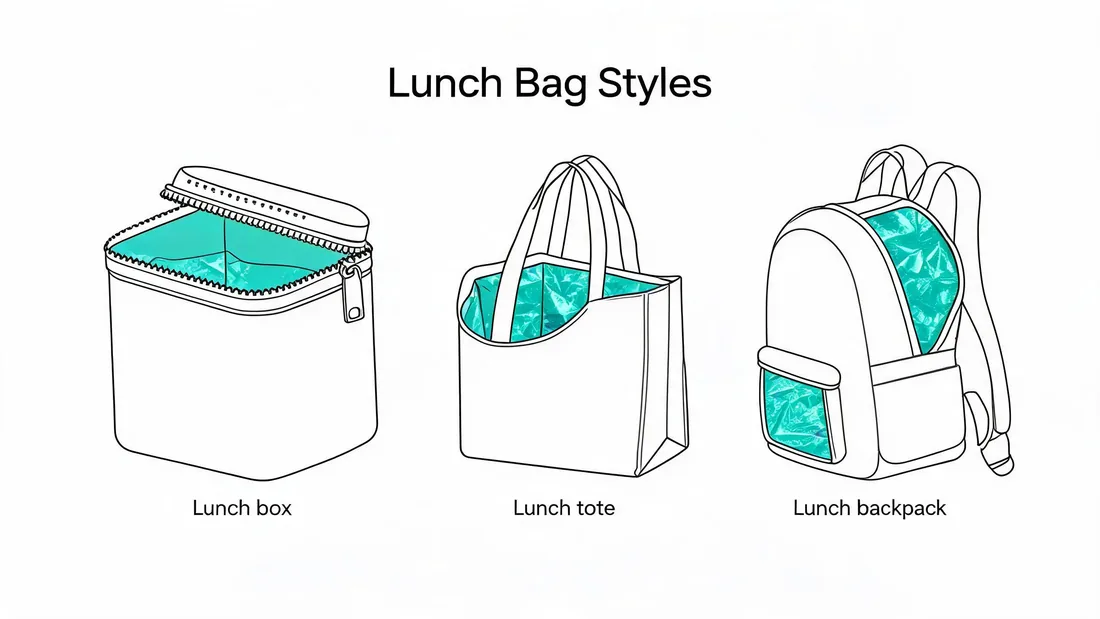
Soft Insulated Lunch Bag, Lunch Tote or Lunch Box Carrier: Which Format Fits Your Program
Three formats, one job. They differ in shape, structure and how the payload enters and leaves.
A soft insulated lunch bag is a collapsible body with a top-opening closure. It squashes flat when empty. Food goes in from above, usually into one main cavity with a small front pocket. Because the walls flex, the insulation is foam panel or foam sheet, and the bag relies on the closure and the liner to manage air exchange and spills.
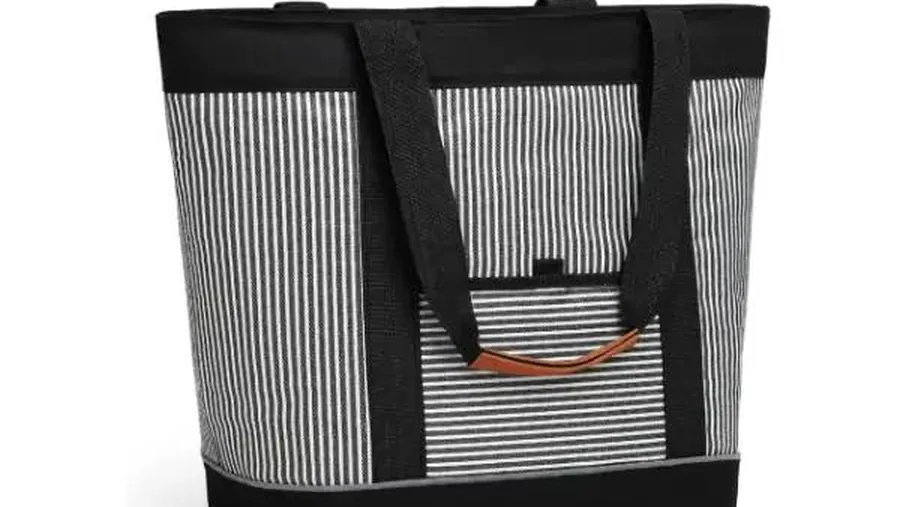
A lunch tote is taller and more upright. It often carries a flat base panel, a longer shoulder strap or dual handles, and sometimes an exterior sleeve for a bottle. The structure holds its shape on a counter or in a locker. That rigidity comes from a board or stiffer foam in the base and side panels.
A lunch box carrier is the most structured of the three. Think of a semi-rigid shell with a defined lid, a moulded or framed interior, and compartments sized around specific containers. It behaves more like a small case than a bag. It stacks well, it protects contents from crushing, and it shows a clean print face.
Format follows payload and carrying pattern. Not price point. A construction crew that throws a bag into a truck bed needs a structured carrier. A commuter who clips a bag to a backpack wants a soft body that folds. A school program that hands a bag to a child wants light weight and a simple closure.
Say a buyer brief lands on your desk: 800 units, three colours, one logo, for a staff wellness program. That brief could be filled by any of the three formats. So the spec has to name the format. If it does not, two suppliers will quote two different products and you will compare numbers that were never comparable.
| Format | Insulation approach | Capacity feel | Best buyer scenario |
|---|---|---|---|
| Soft insulated lunch bag | Foam sheet or panel in flexible walls; radiant barrier often laminated to the liner | Fits a main course plus a snack; squashes flat for storage | School giveaways, high unit counts, tight shipping volume |
| Lunch tote | Foam panels plus a stiffened base; taller wall cavity | Holds a main course, a drink bottle and small items upright | Retail programs and workplace kits where the bag stands on a desk |
| Lunch box carrier | Structured shell with defined lid; thicker foam or board in the walls | Holds fixed containers and protects against crushing | Field crews, medical or shift-work programs, premium retail sets |
The table is a starting point, not a rule. Real capacity depends on wall thickness and how the interior is divided, and those values come from the approved specification, not from a product photo.
Insulation and Liner Options for Insulated Lunch Bags in Bulk
Almost every insulated lunch bag uses closed-cell foam as the insulation body. Polyethylene and polyurethane foams are the common families. Closed-cell structure resists water absorption, which matters when a liner fails and moisture reaches the foam.
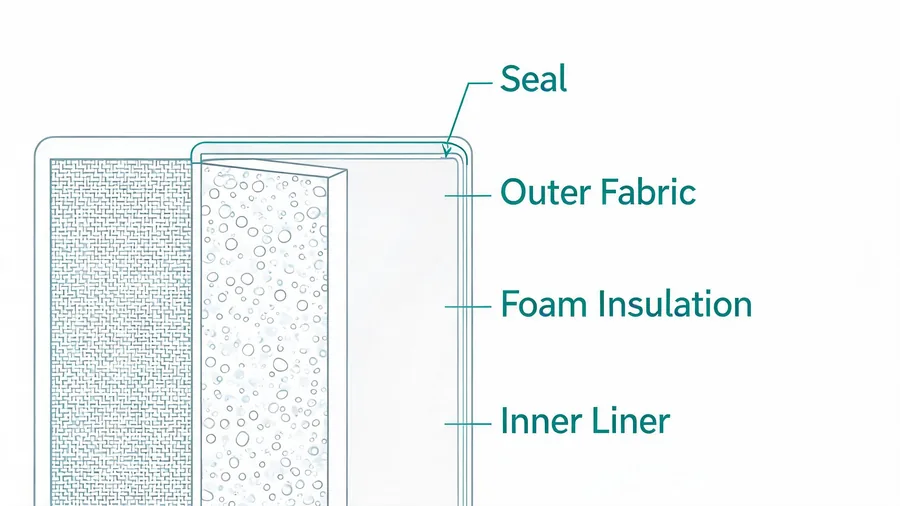
On top of that, many bags carry a metallised film or foil-faced layer. Positioned correctly, that reflective barrier reduces radiant heat transfer. Positioned badly, it does nothing except add cost.
Three things govern how well the stack performs: thickness, cell structure, and continuity. Continuity is the one buyers forget. Where insulation is compressed, interrupted, or replaced by conductive hardware, you get a thermal bridge. A metal plate sewn straight through the wall is a thermal bridge. A strap anchor that crushes the foam is a thermal bridge. A zipper that pinches the wall shut at the corners is a thermal bridge.
Liners are a separate decision. PEVA and EVA films are flexible, cleanable and commonly used for food-contact interiors. Aluminum PET gives a reflective inner face and wipes down easily. Wipe-clean films in general are chosen when the buyer expects spills and wants a surface that does not stain.
Now the part that protects you. Any hold-time claim has to name the test method, the ambient temperature, the starting temperature, the payload, and the refrigerant quantity. A number without those conditions is not a claim, it is a slogan. Ask for the test report and read the conditions before you put anything on a hang tag. For adjacent formats, the same logic runs through a guide to insulated tote bag construction.
Leak Resistance and Wipe-Clean Interiors: What Buyers Should Ask For
Leakproof is a whole-product claim. It applies only when the complete construction, seams and closures included, passes a defined liquid-containment test. A liner that resists water on a flat sheet proves nothing about a finished bag with a stitched bottom.
Water-resistant is a narrower word. It applies to a material or product that has passed a defined water-resistance method. And a material test does not become a finished-product claim. The fabric passed. The bag did not get tested. Those are different statements, and your legal team will care.
So what can you actually specify? Four levers.
- Welded or heat-sealed seams instead of stitched seams at the liner
- A waterproof zipper or a covered closure
- A liner film chosen for liquid containment, not just wipe-clean convenience
- A seam and liner geometry that keeps moisture away from the foam
Condensation is the quiet problem. A cold load in a warm room pulls moisture. If the liner and seam design cannot manage that moisture, it reaches the insulation and the foam degrades over time. Interior pooling, seam leakage and exterior wetness are all evaluated in a condensation test on a cold-loaded bag. Ask whether the construction was tested that way, or only the film.
If the program involves raw food or delivery, the containment question gets stricter. There is a separate breakdown of those requirements in the food delivery insulated bag guide.
Closures, Handles and Shoulder Straps: Matching Hardware to the End User
The closure controls air exchange at the opening. That is its whole job, and it is often the weakest link in the bag.
A zipper gives the tightest practical seal of the three common options, provided the teeth engage fully and the slider closes past the end stop. A roll-top closure folds the mouth over itself several times and secures it, which limits air exchange well but costs the user a few seconds every time. An overlapping flap is the fastest to open and the loosest at sealing.
Here is the counterintuitive part. Opening frequency and zipper gaps can dominate real-use temperature loss even when the wall insulation is excellent. A bag with thick foam and a gaping zipper loses its cold faster than a thinner bag that stays shut. If your end user opens the bag ten times a shift, spec the closure for that, not for the brochure.
Handles and straps come next. Options run from a single top grab handle, to dual short handles, to a detachable shoulder strap, to a full webbing strap with an adjuster. At every high-stress point, a reinforcement patch or a proper webbing attachment decides whether the bag survives month three.
These are testable components. Strap-anchor strength applies a controlled pull to a shoulder strap, handle or webbing attachment to verify the reinforcement. Buckle and adjuster strength measures break strength and slippage under load. Zipper cycling opens and closes the closure repeatedly to check operating force and durability. A buyer can ask for pull-strength verification on the anchor points instead of hoping.
Compartments, Bottle Pockets and Capacity Feel
Layout is a thermal decision, not just an organisational one. A smaller air volume and a fuller load reduce rapid internal temperature fluctuation. An empty bag with a big headspace swings in temperature every time it opens. A packed bag holds its cold.
That is why compartment design matters. A snug main cavity with a divider keeps contents from sliding into dead space. A front zip pocket holds utensils, napkins or a phone, but it sits outside the insulated cavity, so nothing in it stays cold. Mesh pockets and daisy chains add organisation and ventilation without pretending to be sealed.
Bottle pockets deserve their own line in the spec. Describe them by what they hold: a slim bottle, a wide bottle, a can, or a bottle plus a side snack. Mesh and spacer mesh are the usual materials here, chosen for airflow and stretch. Remember that a mesh pocket is not a sealed compartment. If the bottle sweats, the moisture goes somewhere.
You can sanity-check capacity feel without a litre figure. Count containers. Will the bag hold a standard lunch box plus a drink? Two stacked containers and a can? A bottle standing upright next to a main course? That count is more useful to your end user than any volume number, and it is easier to verify on a sample.
Print Area, Colourways and Logo Methods in a Bulk Lunch Bag Program
Outer shell choice drives printability. Polyester is dimensionally stable, widely printable, and available in many weights, weaves and coatings, which is why it dominates promotional work. Nylon brings strength-to-weight and abrasion resistance, but its coating and weave change how ink and heat transfer behave. Canvas takes print well and shows texture. Ripstop has a grid structure that can interfere with fine detail. Recycled polyester options exist across several of these families, and they are worth asking about early.
Colourway count interacts with a bulk run in a way that surprises first-time buyers. Every additional Pantone-matched colour is a separate setup, a separate run segment, and a separate chance for a shade to drift. Specify the Pantone reference before sampling, not after. A colour approved on a screen is not approved. Colour matching to a stated tolerance is a normal part of sampling, and colourfastness to rubbing is a testable property that matters when print sits against clothing or hands.
Logo methods you can request:
- Woven label
- Metal plate
- Heat-pressed PVC
- Laser marking
- Reflective application
- Hidden label
- Interchangeable logo system
Each method has its own minimum quantity and its own artwork requirement, and those values belong in the approved specification for your project. Do not assume one method works for every colourway or every shell fabric. Ask which methods suit the shell you chose.
For wellness kits and giveaway programs, there is a fuller treatment of decoration and gifting angles in the promotional cooler bags section.
Writing the Spec Before You Ask for a Quote
A vague brief produces quotes you cannot compare. Here is a checklist you can copy.
- Format: soft bag, tote or box carrier
- Finished dimensions, plus the measurement method
- Outer fabric family and weight
- Insulation type and thickness
- Liner material and finish
- Closure type
- Handle or strap type, with attachment points
- Interior layout and bottle pocket description
- Print size, placement and colourway count, with Pantone references
- Logo method
- Packaging format
One more distinction to write down. Material tests and product tests are different things. Tensile strength, tear strength, abrasion resistance, seam strength and coating adhesion test materials and components. Static load, dynamic load, strap-anchor strength, leak testing, thermal testing and drop testing test the finished product. If you need a product-level claim, the spec should say so, and it should say which test supports it.
That is what claim control means. The wording on the bag matches the test that was actually run. Water-resistant only after a defined water-resistance method. Waterproof only when the whole construction meets the stated waterproof conditions. Leakproof only after a liquid-containment test on the complete product. Hold time only with ambient temperature, starting temperature, payload, refrigerant quantity, bag size and pass criterion attached.
Bulk orders can move by sea, rail or air, and small parcels can go door-to-door by express courier. Which mode fits depends on your volume and your deadline, and that conversation belongs in the quote stage.
Send a spec and the team will quote against it. Start from the product range, or read the wider sourcing walkthrough at bulk insulated bags sourcing, then reach out through the contact page with your format, dimensions and print requirements.
FAQ
What is the difference between a soft insulated lunch bag and a lunch box carrier?
A soft insulated lunch bag has flexible foam walls and collapses flat when empty, so it packs and ships efficiently. A lunch box carrier has a semi-rigid shell with a defined lid and framed interior, so it holds its shape, protects contents from crushing and presents a flat print face. The soft bag suits high-unit school and giveaway programs. The carrier suits field crews, shift work and premium retail sets where structure matters more than packability.
Can a lunch bag be called leakproof?
Only when the complete product, including seams and closures, passes a defined liquid-containment test. A liner that resists water on a flat sheet does not make the finished bag leakproof, because a stitched bottom or an uncovered zipper can still let liquid through. If leak containment matters to your program, ask which construction was tested and request the report rather than accepting the word on a hang tag.
How do I choose between a soft lunch bag, a lunch tote and a lunch box carrier for one brief?
Start with the payload and the carrying pattern. Count what has to fit: a main course, a bottle, stacked containers, a can. Then ask how the user carries it and how often they open it. A bag thrown into a truck bed needs structure. A bag clipped to a backpack needs to fold. A bag that sits upright on a desk needs a stiffened base. Once the format is named in the spec, quotes from different suppliers become comparable.
What should go in a lunch bag spec sheet before requesting a quote?
Format, finished dimensions and the measurement method, outer fabric family and weight, insulation type and thickness, liner material and finish, closure type, handle or strap type with attachment points, interior layout and bottle pocket description, print size and placement, colourway count with Pantone references, logo method, and packaging format. Add a line stating which claims need a product-level test, so the supplier knows what has to be verified on the finished bag rather than on the material.